

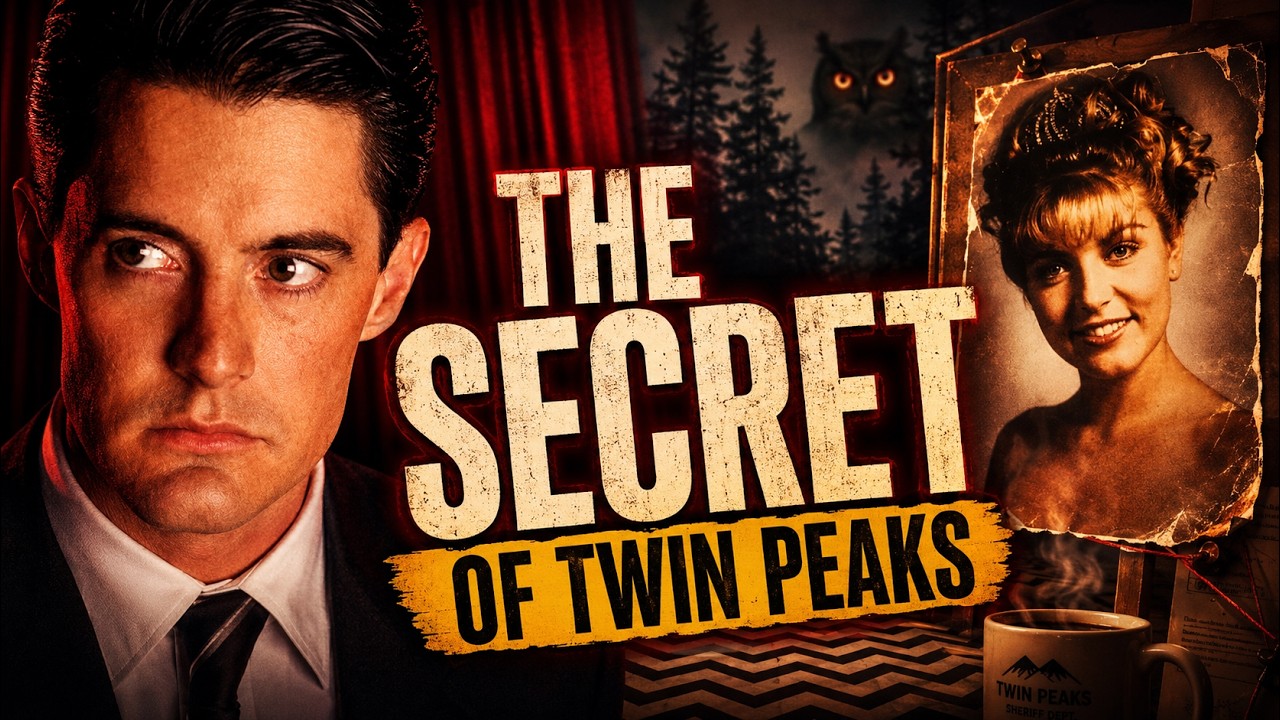
Twin Peaks opens with an image that burns itself into your memory: a body, wrapped in plastic, discovered on the rocky shore of a lake. “She’s dead… wrapped in plastic,” says a horrified Pete Martell over the phone—and with that sentence, not only does a murder investigation begin, but one of the most enigmatic series ever made is set into motion. Yet Twin Peaks is more than a murder mystery. It’s a journey into a world where reality and dream, horror and beauty are inseparably intertwined.
Created by David Lynch and Mark Frost, Twin Peaks premiered on ABC in April 1990 and immediately changed the landscape of television. They didn’t just tell a story—they dismantled traditional narrative structures and built a world where the familiar could suddenly turn strange. Twin Peaks isn’t your average mystery-thriller. It’s an experiment, a meta-commentary on television itself, a meditation on time, identity, and the nature of evil. The series asks viewers to embrace unpredictability, to lose themselves in symbolism and surreal moments, and above all, to accept one core truth: not every question has an answer.
The first two seasons center on a seemingly straightforward question: Who killed Laura Palmer? FBI Special Agent Dale Cooper arrives in the small Pacific Northwest town of Twin Peaks to investigate—and is quickly drawn into a labyrinth of secrets, lies, and supernatural forces. But the show doesn’t follow a classic whodunit path. Instead of offering a neat resolution, the murder case becomes a mirror reflecting the hidden darkness of the town. Every character harbors a secret, a hidden truth that slowly comes to light. In Twin Peaks, evil isn’t just a lone killer—it’s a pervasive presence embedded in the fabric of the town itself.
Spoilers: detailed discussionContains story spoilers. Open deliberately.
From the cliffhanger to Fire Walk with Me
Season two faces a narrative challenge: Laura’s killer is revealed relatively early, creating a rupture in the show's momentum. But instead of simply continuing the story, Twin Peaks morphs into a full-blown nightmare. The series briefly loses focus in the middle stretch, but then comes the finale—a disturbing, surreal crescendo that leaves viewers stunned. Dale Cooper, once the unshakable hero, is overcome by dark forces. The final scene shows him grinning maniacally at his reflection, with the demonic figure of Bob staring back from the mirror. It’s one of the boldest cliffhangers in television history—and for more than two decades, it remained unresolved.
After the show’s abrupt cancellation in 1991, it seemed the Twin Peaks story was over. But David Lynch wasn’t finished. Instead of producing a traditional sequel, he made the 1992 film Twin Peaks: Fire Walk with Me, a prequel that shifted tone entirely. Gone was the quirky small-town charm; in its place was a slow, harrowing descent into trauma and darkness. Rather than answering the lingering questions from the series, the film focuses on the final seven days in the life of Laura Palmer. What had previously existed only in flashbacks and fragmented memory becomes brutal reality.
Fire Walk with Me no longer portrays Laura Palmer as the innocent victim we first imagined. Instead, she emerges as a deeply broken figure, trapped in a hell of abuse, drugs, and existential dread. Her killer is not just her father, Leland, but also Bob—the terrifying embodiment of an elusive evil that lurks deep within the woods surrounding Twin Peaks. The film takes the dreamlike quality of the series and compresses it into a suffocating, disturbing vision. There is no humor here, no quirky subplots, no charming oddballs—just a relentless descent into a grim reality with no escape.
When it was released in 1992, Twin Peaks: Fire Walk with Me was widely rejected by critics and audiences alike. Many fans were frustrated that it ignored Agent Cooper’s fate and the unresolved threads of the series. But over time, Fire Walk with Me has undergone a dramatic reevaluation. Today, it’s recognized as an essential piece of the Twin Peaks universe. It’s not just a retelling of Laura’s story—it’s a crucial key to understanding Twin Peaks: The Return, which wouldn’t arrive for another 25 years.
The Return and the hero withheld
And then, a quarter-century after the series finale, it came: Twin Peaks: The Return. But instead of offering a nostalgic homecoming, David Lynch dismantled every expectation and created something entirely new. The Return, which premiered on Showtime in 2017, is not a straightforward continuation—it’s a radical deconstruction of what television can be. From the first episode, it’s clear: this is no longer the Twin Peaks we once knew. Much of the story doesn’t even take place in the town itself, and many familiar characters appear only briefly. The biggest shock for longtime fans: Dale Cooper, the character who anchored the original series, is almost entirely absent in his original form.
Instead of returning to restore balance, Cooper—after being trapped in the Black Lodge for decades—is reincarnated into the identity of Dougie Jones, a mentally vacant, almost childlike shell of a man. For nearly 16 episodes, Dougie stumbles passively through his life, barely able to speak, reacting only to specific stimuli, utterly helpless. What seems at first like a cruel joke can, for me, be read as one of the series’ most profound metaphors: Dougie represents the television audience. He sits, he absorbs, he watches the world unfold around him, but he doesn’t act. He’s a consumer, not a participant.
With this move, Lynch denies the audience any easy gratification. There is no quick reunion with the old Cooper, no comforting structure. Instead, The Return becomes a near-meditative experience that challenges viewers to reflect on the medium of television itself. It’s a work that demands patience and attention—one not every viewer is willing or able to give.
Part 8: images of evil’s origins
One of the most fascinating episodes of Twin Peaks: The Return is Part 8—a high point of the series and a total break from conventional storytelling. It starts innocuously enough, but soon David Lynch leads viewers into an unprecedented audiovisual experiment. The episode jumps back to 1945, to the first atomic bomb test in the New Mexico desert. This moment, a real-world historical event, is portrayed in Twin Peaks as the birth of ultimate evil. In the heart of the explosion, a grotesque, shadowy figure emerges—and from it, Bob is born. The dark force that has haunted Twin Peaks from the beginning is given a chilling origin story.
What follows is nearly twenty minutes of wordless, surreal imagery. The viewer is pulled into a vortex of nightmarish sequences, accompanied by thunderous sound design and disturbing black-and-white visuals. One of these scenes features a terrifying entity—the so-called “Experiment”—vomiting a massive, egg-like substance, inside which we glimpse Bob. But is Bob the only thing born here? Or is this creature actually Judy, the dark force Phillip Jeffries cryptically referenced in Fire Walk with Me? If Judy represents the ultimate evil, then Bob might merely be one of her manifestations—or a servant acting on her behalf.
Later, we see a mysterious young girl sleeping at night, while a grotesque creature—part insect, part frog—crawls into her mouth. Could she be a young Sarah Palmer? In The Return, Sarah is one of the most deeply unsettling figures. At times, she appears perfectly ordinary—only to suddenly reveal something inhuman and horrifying beneath the surface. Could this moment in Part 8 be the origin of her fate? Was she infected by a dark force that only decades later reveals its true form?
These images are intentionally ambiguous, but the message is unmistakable: the evil in Twin Peaks is not just a person, not just a ghost. It is a vast, ancient presence, woven deep into the fabric of the world.
This episode isn’t just one of the boldest moments in television history—it’s also a crucial key to understanding Twin Peaks. It shows that the evil in this story resists simple explanations. It isn’t just Bob, or Leland, or Cooper’s reflection in the Black Lodge mirror. It’s a force that exists beyond time and space, beyond morality, beyond understanding.
Can Cooper change the past?
But The Return doesn’t stop at exploring the nature of evil. Another central theme of the season is memory—and the impossibility of changing the past. In the final episodes, Dale Cooper attempts to do just that: he travels back in time to save Laura Palmer. At first, it seems to work—Laura disappears into the woods, her body is never found. But then reality fractures again. Cooper and Laura find themselves in another world, one where nothing is as it should be. Laura doesn’t recognize herself. Twin Peaks no longer exists in the way Cooper remembers it. And then, in one of the final scenes, Laura hears a sound that terrifies her—she screams, and the entire world seems to collapse.
This final moment is one of the most daring and frustrating endings in television history. Cooper tried to defeat evil, but instead may have created something worse: a reality where nothing makes sense. There is no neat resolution, no triumphant return of the hero. Only the realization that some things cannot be undone.
Characters between guilt and symbolism
Beyond its experimental narrative and thematic depth, Twin Peaks remains unforgettable because of its characters. The series doesn’t settle for presenting classic archetypes—it takes those familiar roles and twists them, making them unpredictable, ambiguous, or deeply tragic.
Leland Palmer is a perfect example. At first, he appears to be a shattered father, crushed by the grief of losing his daughter. But over time, we learn: he’s not just a victim—he’s the perpetrator. His murder of Laura is the central crime of the series. And yet, the question of responsibility remains unresolved. Is Bob an external, demonic force that possessed Leland, or is Bob a symbol for the darkest potential within human beings? Twin Peaks never offers a clear answer. That ambiguity makes Leland one of the most disturbing characters in the series. His death in the cell is both devastating and grotesque.
Audrey Horne, who once appeared in the first two seasons as a seductive, clever rebel, undergoes a tragic transformation in The Return. She is almost unrecognizable. Her scenes are fragmented, disconnected from the rest of the narrative. She seems trapped in a kind of psychotic prison, tethered to a reality that feels artificial and unstable. Her final appearance shows her alone in a white room, confused and terrified. Is she in a psychiatric facility? In an alternate reality? Is she even alive? Her story remains unresolved—and that’s exactly what gives it so much weight. Twin Peaks confronts the inability to let go of the past, and Audrey is one of its most devastating casualties—a character lost in the desperate search for a truth that may not exist.
Alongside its tragic figures, The Return also introduces characters who seem to function more like metaphors. Candie, the silent, seemingly naive assistant to the Mitchum brothers, is one of them. She moves through the world as if tuned to a completely different frequency—detached, absent, sometimes childlike, sometimes almost prophetic. That’s what makes her so fascinating. She resists analysis. She may represent love, or purity, or a kind of innocence long lost in the world of Twin Peaks. Or maybe she’s just another unsolvable piece of a series that refuses to be decoded.
Another symbol-laden figure is Señorita Dido, who appears in The Return within the black-and-white dream realm of the Fireman. Her shimmering silver dress recalls old film reels—suggesting she might represent the medium of film itself. In a series so deeply invested in the tension between film and television, this reading fits its larger concerns. While television is often treated as ephemeral and consumable, film in The Return is sacred. Dido may very well be a guardian of cinema—a protector of a medium that stands apart from the serialized, ever-shifting nature of TV.
Characters like these show how Twin Peaks operates far beyond the limits of traditional storytelling. It’s a series built on symbols, metaphors, and inexplicable connections—a work that compels its audience to continuously find new interpretations.
Light, camera and the hum of electricity
But beyond its characters, Twin Peaks is also defined by its cinematic craft. David Lynch doesn’t just use camera, light, and sound to tell a story—he treats them as artistic tools in their own right. His use of light and shadow is especially striking. Many scenes are lit almost like paintings—warm, soft light in the familiar spaces of the Double R Diner or Cooper’s hotel room contrasts with the harsh shadows and near-monochrome palette of the Black Lodge. Light becomes a symbol of deceptive safety: the sunlit streets of Twin Peaks suggest a peaceful small-town life that doesn’t truly exist.
The camerawork is just as distinctive. Lynch loves placing his camera at unusual angles or holding on faces for uncomfortably long periods, creating an eerie, hypnotic tension. A simple smile can become unsettling through sheer duration. A seemingly harmless conversation turns into something deeply disturbing. In The Return, long, static shots are used to stretch time to its limits—like the unforgettable moment where we watch a woman sitting in a bar, doing nothing but waiting for something that never arrives.
Equally important is the show’s sound design. Lynch is not only a director but an audio-visual artist. In Twin Peaks, sound matters as much as image. The constant hum of electrical devices in many scenes creates an undercurrent of unease, as if some larger, invisible force is always present. Distorted voices, backward-spoken dialogue, and moments of total silence all intensify the show’s surreal, nightmarish tone.
And then there’s Angelo Badalamenti’s music, which plays a near-mythic role in the series. His melancholic jazz, fused with ambient synthesizer textures, creates a soundscape that feels both nostalgic and unnerving. The melodies are iconic—whether it’s the haunting “Laura Palmer’s Theme” or the mysterious, seductive “Audrey’s Dance.” Badalamenti’s score strengthens the sense that everything in Twin Peaks comes from somewhere else, some other dimension. The town isn’t just a town—it’s a place between realities, between dream and waking life.
Spoilers: detailed discussionContains story spoilers. Open deliberately.
Stories reshape reality
But Twin Peaks is more than just a stylistic exercise or cinematic experiment. It’s a series that asks a fundamental question: What does it mean to tell a story? Especially in The Return, the focus shifts away from characters and plot and toward the idea of storytelling itself—how reality is shaped by the narratives we construct. Cooper tries to save Laura Palmer by rewriting her story—only to lose her again in the end. This metanarrative runs through the entire series: characters slip into new roles, stories repeat with variations, and every answer leads to more questions.
This is what makes Twin Peaks more than just a mystery series—it’s a reflection on how we find meaning in stories, and whether a story can ever truly be complete.
A legacy without easy answers
The impact of Twin Peaks on modern television can’t be overstated. When the show premiered in 1990, television was still largely formulaic. Series followed clear structures, storylines had to be resolved, and experimentation was rare. But Twin Peaks broke all those rules. It demanded patience from its viewers, a willingness to embrace the unexpected, and an acceptance that not every question needs an answer. At the time, that was revolutionary—and it laid the groundwork for what we now call prestige or “quality TV.”
Series like Lost, The Leftovers, True Detective, or Fargo clearly bear the imprint of Twin Peaks. The use of open-ended questions, surreal moments, and non-linear storytelling has become a staple of many modern productions. Yet while these shows often strive to provide the audience with at least some answers, Twin Peaks remains, to the very end, a series that defiantly resists resolution. That’s what makes it so unique.
But Twin Peaks isn’t just a milestone in the history of television—it’s also an emotional experience. Laura Palmer’s tragedy is palpable. Leland Palmer’s madness is deeply unsettling. Dale Cooper’s disorientation in The Return is almost painful to watch. Every character is trapped in their own way—by the past, by another reality, or by a story that keeps rewriting itself. These characters aren’t just symbols or puzzle pieces in some grand mystery—they’re deeply human. They fail, they suffer, they fight.
One of the most striking aspects of The Return is how it deals with time. The series takes place twenty-five years after the events of the original, and that sense of time passing is central to the experience. There’s no feeling of continuity, no simple return to familiar patterns. The characters have changed. Some no longer exist. Others are merely shadows of who they used to be. The nostalgic revival many viewers hoped for never arrives—instead, the audience is met with a series that feels like a ghostly memory of what once was.
Verdict
In the end, Twin Peaks remains one of the greatest enigmas in the history of television. There are shows you watch and forget. And then there’s Twin Peaks. It’s a work that lingers. Even years later, you find yourself thinking about certain scenes—the hum of electricity, Cooper’s haunted stare. It’s a series that gets under your skin, one that reveals new layers with every rewatch, and one that, even after all these years, still feels as radical as it did when it first aired.
But Twin Peaks isn’t for everyone. It’s not a series that offers easy answers. It can’t be summed up in a sentence. It’s a riddle that keeps shifting. For those willing to embrace the mystery, it’s one of the most captivating journeys television has ever offered. For those seeking clear solutions, it will disappoint. But for anyone ready to surrender to the unknown, there’s nothing else like it. Twin Peaks isn’t just a show—it’s an experience you never forget.
Watch the film at home
For your home collection
Check format, audio, region compatibility and current availability on Amazon.
As an Amazon Associate I earn from qualifying purchases. Using these links does not add to the price you pay.