

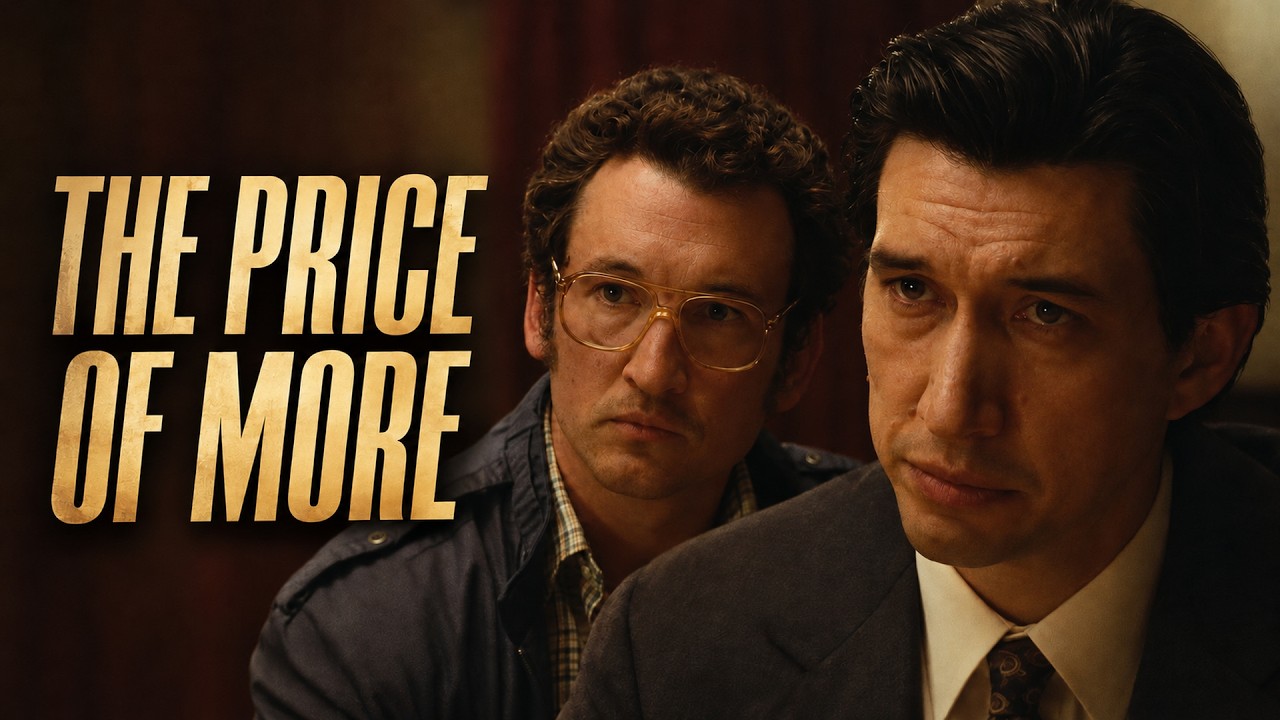
A promise of easy money
Your brother promises easy money. The frightening part is how badly you want to believe him.
The deal on the Gowanus Canal
Paper Tiger brings James Gray back to the family crime drama. Adam Driver and Miles Teller play brothers in nineteen eighty-six New York. Gary is an ex-cop with connections and a confident answer for everything. Irwin is an engineer with a wife, two sons, and bills that make a little extra money sound very useful.
Gary offers him consulting work around Brooklyn's polluted Gowanus Canal. The clients are Russian businessmen. Irwin thinks his expertise will help him do an honest job. Gary thinks he understands the people paying for it. That gap between what each brother knows and what each brother needs to believe is where the tension lives.
Driver and Teller as brothers
Driver gives Gary an inviting swagger. He can fill a room before anyone has checked whether his story holds together. The performance works because the charm and the insecurity belong to the same man. Confidence becomes a way of asking his family not to look too closely.
Teller supplies the quieter counterweight. Irwin has skills, responsibilities, and a reason to be proud. He also wants the security his brother seems to offer. Their differences give the film more to work with than a simple contrast between a good brother and a bad one.
What the family already has
Gray's strongest idea is that the family already has something valuable before the deal arrives. Ordinary dinners and shared rooms establish what money cannot simply replace. The crime story matters because these people have a life outside it. When the pressure rises, protecting that life and protecting their pride become harder to separate.
Rooms, period detail and score
The visual style helps. Cinematographer Joaquin Baca-Asay gives the rooms warm, subdued colors and a worn texture. The period setting feels inhabited rather than arranged to show off fashionable eighties references. Christopher Spelman's orchestral score adds weight without turning the brothers into action heroes.
Where the drama strains
There are limits. Some decisions ask for more belief than the characters have earned. The machinery of the crime plot can feel less convincing than the conversations it produces.
And Scarlett Johansson brings force and concern to the family scenes, but her separate storyline does not always receive the same room to develop. The film reaches for tragedy, and sometimes the writing pushes that feeling too hard.
Why the brothers matter
That makes Paper Tiger a better prospect for viewers drawn to character and atmosphere than for anyone wanting a tightly engineered caper.
Its appeal is the friction between two men who love one another and cannot admit how little control they have. Driver's larger gestures need Teller's restraint. Without that balance, Gary could become an entertaining distraction from the family at the center.
The question underneath the deal is simple. What happens when providing more for your family becomes an excuse to stop seeing what they already need from you?
U.S. cinema release in the video
Paper Tiger is in US theaters now, with its nationwide expansion on November twentieth.
Verdict
Go in for the brothers and the uneasy domestic detail. The plot is less sure-footed than the performances, but the tension between affection, ambition, and pride gives this crime drama its strongest reason to exist.