

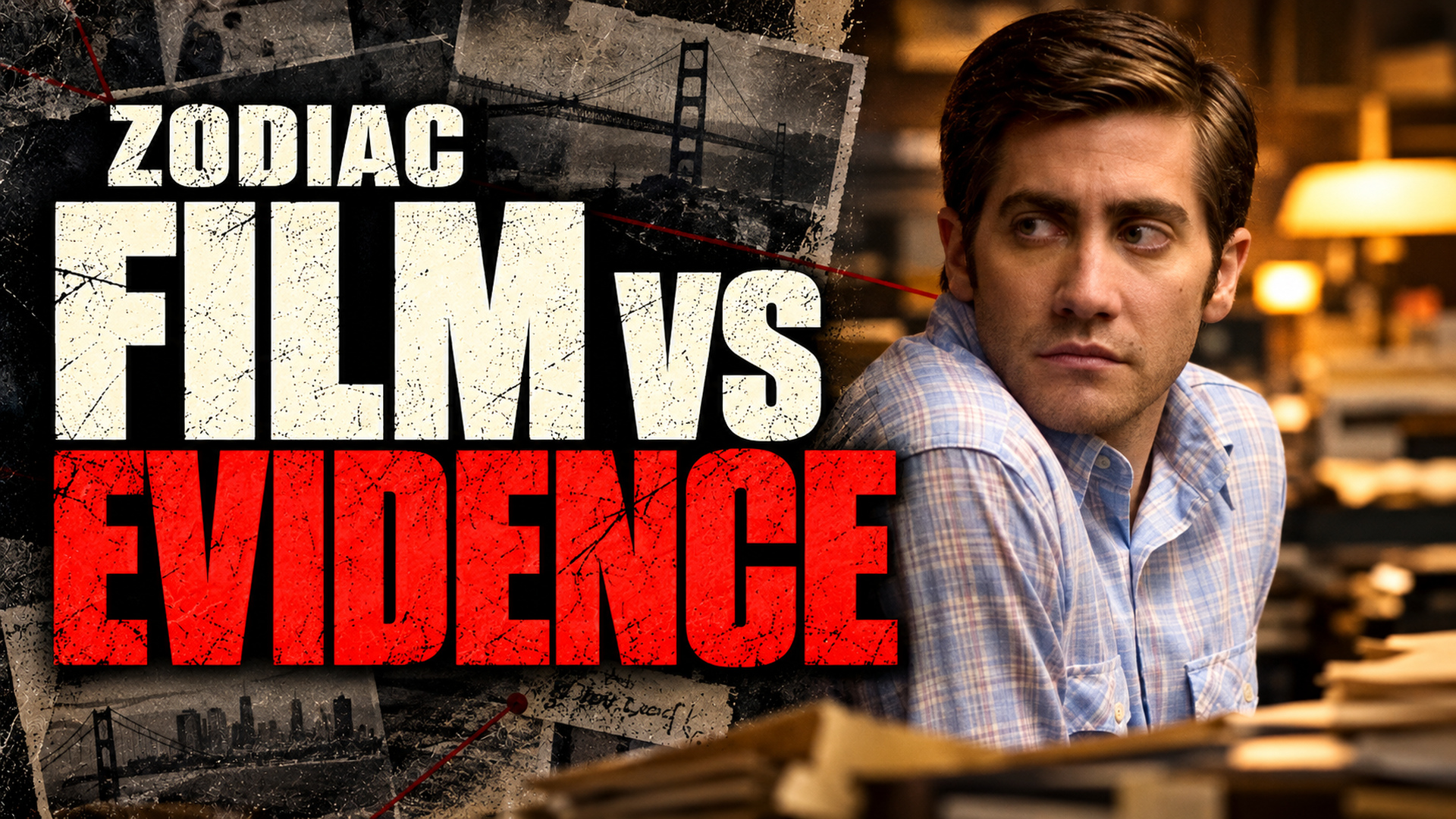
When a film feels like proof
A film can make a suspect feel guilty long before the evidence can. Zodiac builds its mystery around that gap. David Fincher gives us a trail that feels increasingly convincing. But what comes from the real investigation, and what comes from the way the story is told?
Graysmith’s point of view
Start with the point of view. This is not a complete history of every suspect and every lead. The film adapts Robert Graysmith's books and follows his growing involvement in the case. He worked as a cartoonist at the San Francisco Chronicle. He was not the detective officially in charge. That choice matters. We experience the case through someone who keeps searching when certainty stays out of reach.
Research and selection
Fincher said the production checked Graysmith's material against reports, documents and interviews. When memories conflicted, he said they preferred the police reports. That is a serious research method. It still produces a selected narrative, shaped for a film. A scene can faithfully reflect someone's account without making that account the final truth.
Reconstructing Lake Berryessa
Look at the reconstruction of Lake Berryessa. The production consulted survivor Bryan Hartnell and officers connected with the investigation. Their accounts helped shape the scene. The crew even brought in oak trees to replace ones that were no longer there. Those images are a dramatic reconstruction, not a camera recording from 1969. Keeping that distinction in mind changes how we watch. The detail creates a sense of being there. It cannot let us see what nobody could reliably establish.
Local investigators and FBI support
The investigation also belongs to more people than a thriller can keep in the foreground. The original murder inquiries were handled by local authorities. The FBI supplied expertise in handwriting, fingerprints and codebreaking. Its records describe support for those agencies. There was no single investigator with every answer sitting in one file. The film has to turn that scattered work into a story we can follow.
Suspicion is not proof
Then there is Arthur Leigh Allen. The film presents him as a suspect. That does not establish his guilt. A persuasive sequence of clues can make us feel that the pieces have clicked into place. But suspicion and proof do different jobs. A sequence is still an argument, not a verdict. A look, a pause or a carefully placed reveal can settle an emotion. None of them replaces evidence. That is why the film's focus on obsession needs to stay separate from any verdict about the killer. Graysmith's commitment gives the story its momentum. Commitment does not make a theory correct. The closer we feel to him, the easier it becomes to want his answer to be the answer.
What the cipher did—and did not—solve
One important development happened after the film. In 2020, David Oranchak, Sam Blake and Jarl Van Eycke solved the 340-character cipher. The FBI independently verified their solution. It was a real breakthrough after 51 years. But the decoded message did not identify the killer. Solving a document and solving a murder are different achievements. So the useful question is not simply whether Zodiac gets every detail right. Ask whose perspective shapes a scene, what its source actually establishes, and where the film supplies an emotional connection. Its precision can pull us towards certainty. The history asks us to keep checking what we can prove.
Watch at home
Prime Video
For your home collection
Two-Disc Director's Cut.