

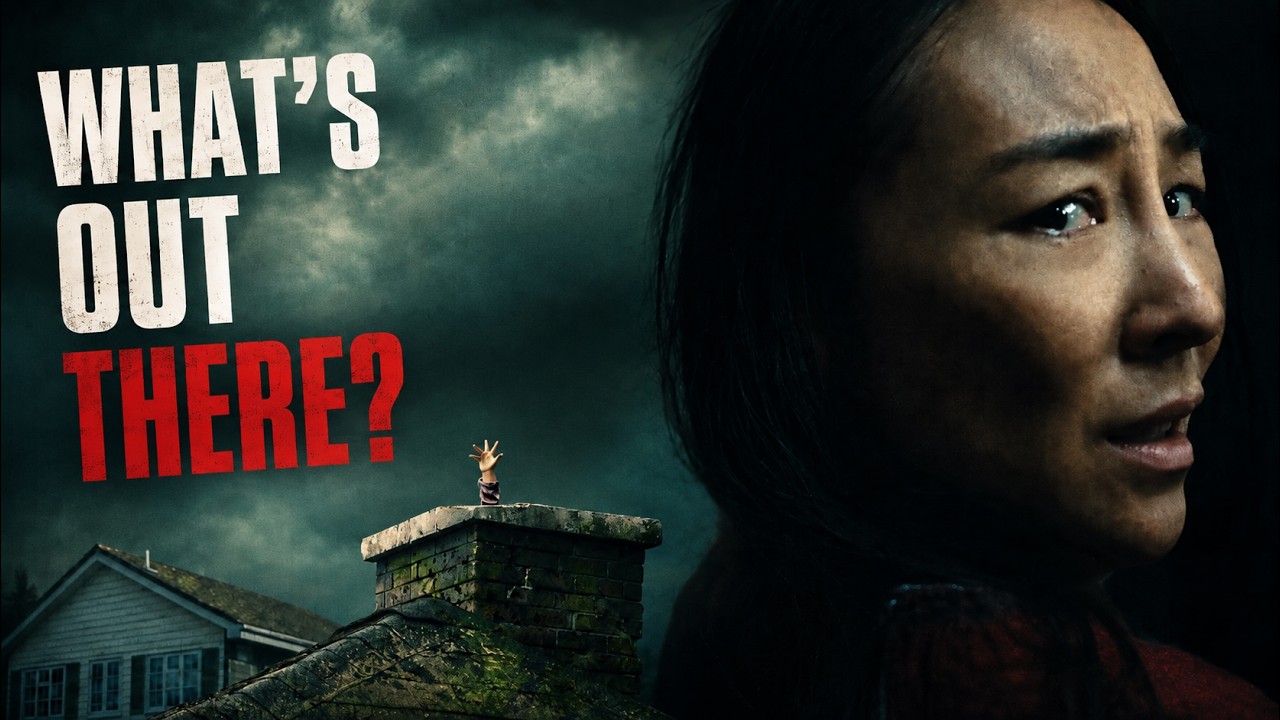
The Last House has a premise that is almost aggressively simple. Ann and Jason are about to leave home with their children, Graham and Ruth, when every door and window suddenly refuses to open. Communications fail, relentless rain covers the neighborhood, and the family has no idea what is keeping them inside.
The movie is strongest when it takes that setup seriously. Louis Leterrier initially avoids rushing toward spectacle and focuses on practical survival. How do you ration food? How do you create routine when help never comes? What does months of isolation do to a family? That gives The Last House an obvious post-pandemic resonance without turning it into a literal COVID drama. Home is supposed to represent safety, but here that sense of security gradually becomes another form of confinement.
Wagner Moura gives Jason a forceful presence and keeps the movie grounded when the screenplay starts losing control. Greta Lee plays Ann with more restraint, although the script gives her fewer sharply defined moments. The family dynamic matters more than any single performance. Their unity helps them survive, but it cannot erase fear, frustration, and the pressure created by endless uncertainty. The house itself almost becomes the most interesting character. Tight rooms, sealed exits, and glimpses of the outside world create more tension than the eventual threat. Leterrier benefits from the restricted setting because every physical change inside the house immediately matters. Yair Elazar Glotman’s score also works well, shifting between domestic warmth and low-level menace without overwhelming the quieter survival scenes.
That is also where the central weakness appears. The longer The Last House delays its answers, the more impressive those answers need to be. When the film moves more openly into science fiction and horror, the payoff cannot quite match the setup. Several ideas feel bigger than the screenplay has prepared for, and some of the claustrophobic power disappears once the story starts explaining its mythology. The dialogue can also sound overly polished, with lines that feel designed for a trailer rather than spoken by people who have spent an extreme amount of time under pressure.
That is frustrating because the core idea could have supported a leaner and much harsher movie. The film is often more convincing when it concentrates on practical survival methods and the family’s improvised routines than when it reaches for a larger mythology. Instead, at almost two hours, The Last House begins to feel stretched, and its final act creates more questions than satisfying answers.
Still, this is not a total failure. Much of the first two thirds is atmospheric, Moura and Lee keep weaker material watchable, and the image of a family home becoming a prison is memorable. For a tense movie night, it works well enough. As a major science-fiction thriller, it leaves too much of its potential unused. The Last House earns five and a half out of ten.