

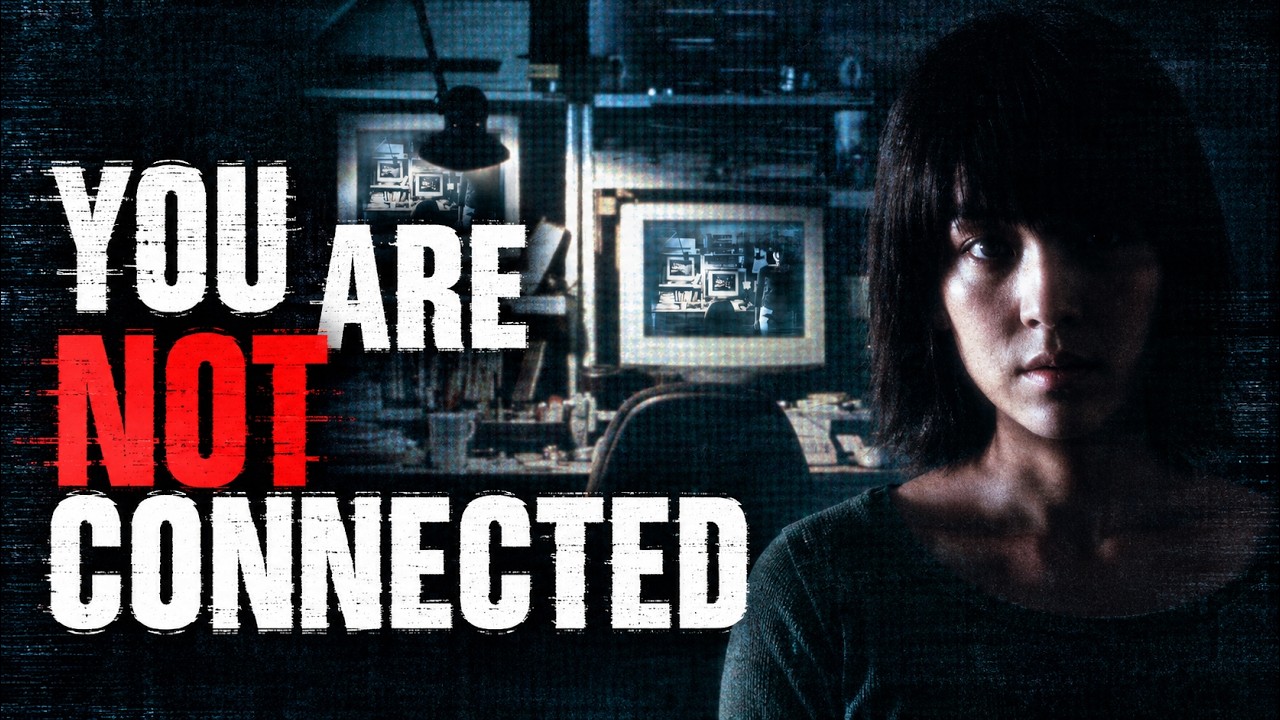
Connected, but never quite together
What if you could reach someone at any moment, yet nobody felt truly present? An old horror movie gives that fear a disturbing shape. Released in 2001, Kiyoshi Kurosawa's Pulse, originally titled Kairo, tells a story about ghosts and computers. Its deepest horror grows from something familiar even without a supernatural explanation: people lose contact with each other while their technological connections remain intact. The pace is slow, the surface uninviting, and the images remarkably persistent. There are spoilers ahead, including the ending.
Spoilers: detailed discussionContains story spoilers. Open deliberately.
Two stories of disappearing contact
Two stories initially unfold in parallel. Michi works at a plant nursery, where the death of her colleague Taguchi is followed by further disappearances. Elsewhere, a student named Ryosuke tries to get online. Disturbing images of isolated people appear on his computer. Harue, who understands the technology, helps him investigate. Kurosawa brings these strands together later. Long before that happens, they share an unmistakable feeling: human connections are breaking down everywhere.
A window that becomes another wall
The computer promises access. Its images reveal people who seem impossible to reach. We can see them, but visibility doesn't create intimacy. That's the film's deeply unsettling idea. A camera can show us somebody without allowing us into their life. A room on a screen is still a room where somebody sits alone. The window onto other people becomes a boundary of its own.
Distance fills the frame
Kurosawa extends that feeling beyond the monitors. Characters occupy wide spaces, separated by doors, glass, and patches of shadow. We can see their surroundings without feeling comfortably oriented within them. Conversation rarely closes the distance. Even when two people share the frame, the space between them sometimes seems greater than any attempt at closeness can overcome.
The body that moves slightly wrong
One encounter with a slowly approaching woman makes this especially vivid. Her movement briefly slips off balance. An ordinary human body does something that looks subtly wrong. Kurosawa gives us time to register the mismatch. Looking away would offer relief, but the film keeps us inside the situation. Something familiar has stopped behaving in a way we can trust, and we have to keep watching it approach.
Red tape cannot make the threat legible
Doors sealed with red tape give the danger a conspicuous marker. A warning like that suggests a boundary: safety ends here. Yet it never develops into a dependable set of rules. The suggestion that the world of the dead has become overcrowded is also a theory offered within the story. It provides one possible way of imagining these ghosts, without becoming a fully verified account of how their world works.
A city emptied of its people
As people disappear, the scale changes. An unsettling incident among colleagues grows into a catastrophe affecting an entire city. Empty streets and abandoned locations make the collapse visible. The world ends by losing its inhabitants. Ordinary places remain as shells. Those deserted spaces are so desolate precisely because we understand what they used to be for, and can imagine the people who should still be there.
The desire for contact is not the mistake
Pulse doesn't simply blame foolish internet users. Ryosuke wants contact, Harue struggles with loneliness, and Michi tries to reach other people. Their needs are understandable. What's distressing is how little they can do to resist the collapse. The film expresses a fear that extends beyond its ageing computers: we might be able to learn about one another without becoming available to one another.
When distance also weakens the story
Kurosawa doesn't make all of this flow effortlessly. The shifting characters and withheld explanations can weaken the narrative connections. Some passages last longer than their ideas sustain. That distance also costs the film emotional immediacy. Yet its difficulty fits a world where communication itself is becoming harder. The images keep working even when the story appears to stall.
What remains on the ship
At the end, Michi and Ryosuke escape onto a ship. But leaving together cannot undo his encounter with a ghost, and he eventually fades away too. What remains for Michi is the memory of their connection. It couldn't prevent the collapse. That doesn't make it meaningless.
An image of loneliness that stays
Pulse gives loneliness an unsettling physical form. You can see somebody, stand beside them, and still lose them. A disturbing, uncompromising film whose strongest images linger long afterward: 9 out of 10.