

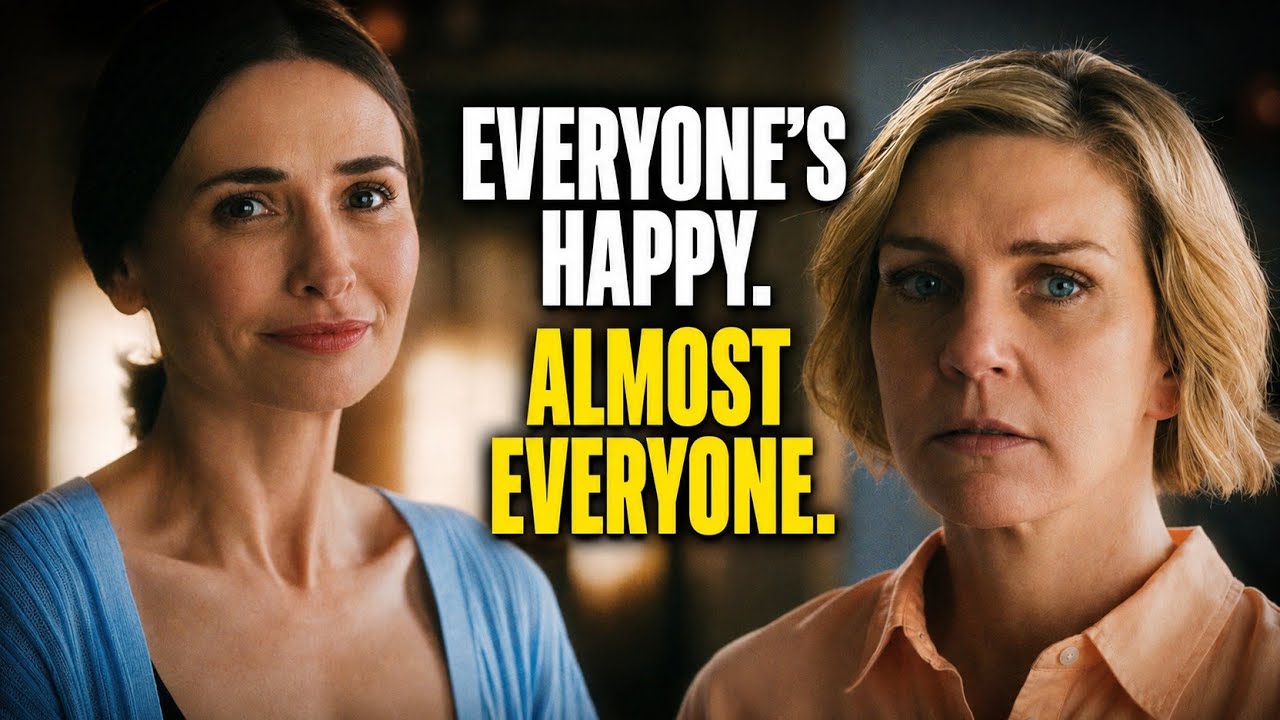
Pluribus is a series that makes its intentions clear from the very first minute. This is not comfort television, and it has no interest in soothing its audience. The premise is both precise and deeply unsettling: a global event triggers a condition that pushes nearly all of humanity into a state of constant happiness. People become calm, friendly, cooperative, emotionally regulated. Extreme feelings disappear. Only a small group remains immune, among them Carol, a successful novelist who embodies everything this new world wants to erase: anger, grief, doubt, loneliness. Pluribus is not about the end of civilization, but about the quiet erasure of individuality.
Carol is the emotional core of the series. She is not written to be likable in any conventional way. She is abrasive, cynical, often difficult to stay with, and deliberately resistant to easy empathy. Rhea Seehorn plays her as a fully functioning adult who has learned to live with internal chaos rather than resolve it. Carol does not collapse under her unhappiness; she carries it with discipline. Placing such an unhappy person in opposition to this new harmony gives the show its sharpest tension. Happiness here is not portrayed as a goal, but as a social standard that eliminates everything that does not conform.
The storytelling is intentionally slow. Pluribus refuses urgency and spectacle. Instead of explaining everything or racing toward escalation, it focuses on gradual shifts. Conversations become flatter. Emotional responses grow predictable. Relationships lose friction. The people affected by the condition are not threatening or hostile. They are polite, warm, and endlessly reasonable. That politeness becomes disturbing over time. The series understands that true horror does not require violence, only the absence of resistance.
Visually, the show is restrained and controlled. The world of Pluribus is clean, bright, and impersonal. Even private homes feel like extensions of public space. The camera often keeps its distance, observing rather than immersing. Close-ups are rare, and when they do appear, they feel earned. Music is used sparingly, with silence doing most of the emotional work. The aesthetic reinforces the idea of a society that has sanded down every sharp edge.
As the season progresses, the focus narrows from the phenomenon itself to its consequences. Carol encounters other immune individuals, and the series avoids turning them into a unified resistance. They are fractured, fearful, and unsure whether survival outside the collective is a gift or a burden. Attempts at intimacy are complicated by the knowledge that pain is no longer a shared experience. Love becomes dangerous precisely because it cannot be evenly distributed.
The final stretch of the season is where Pluribus becomes most precise and most cruel. Abstract ideas turn into irreversible choices. The question is no longer whether the system is flawed, but what it costs to reject it. The finale does not offer catharsis or a clean resolution. It centers on a decision that is neither heroic nor morally pure. The show refuses to comfort the audience, and that refusal feels intentional rather than evasive.
For me, Pluribus is one of the most uncompromising series of the year. It is demanding, deliberately paced, and often uncomfortable to watch. But it knows exactly what it wants to explore and never retreats from its central idea. I land at a strong nine out of ten. Not because it is flawless, but because it treats emotional pain not as a problem to be solved, but as an essential part of being human.