

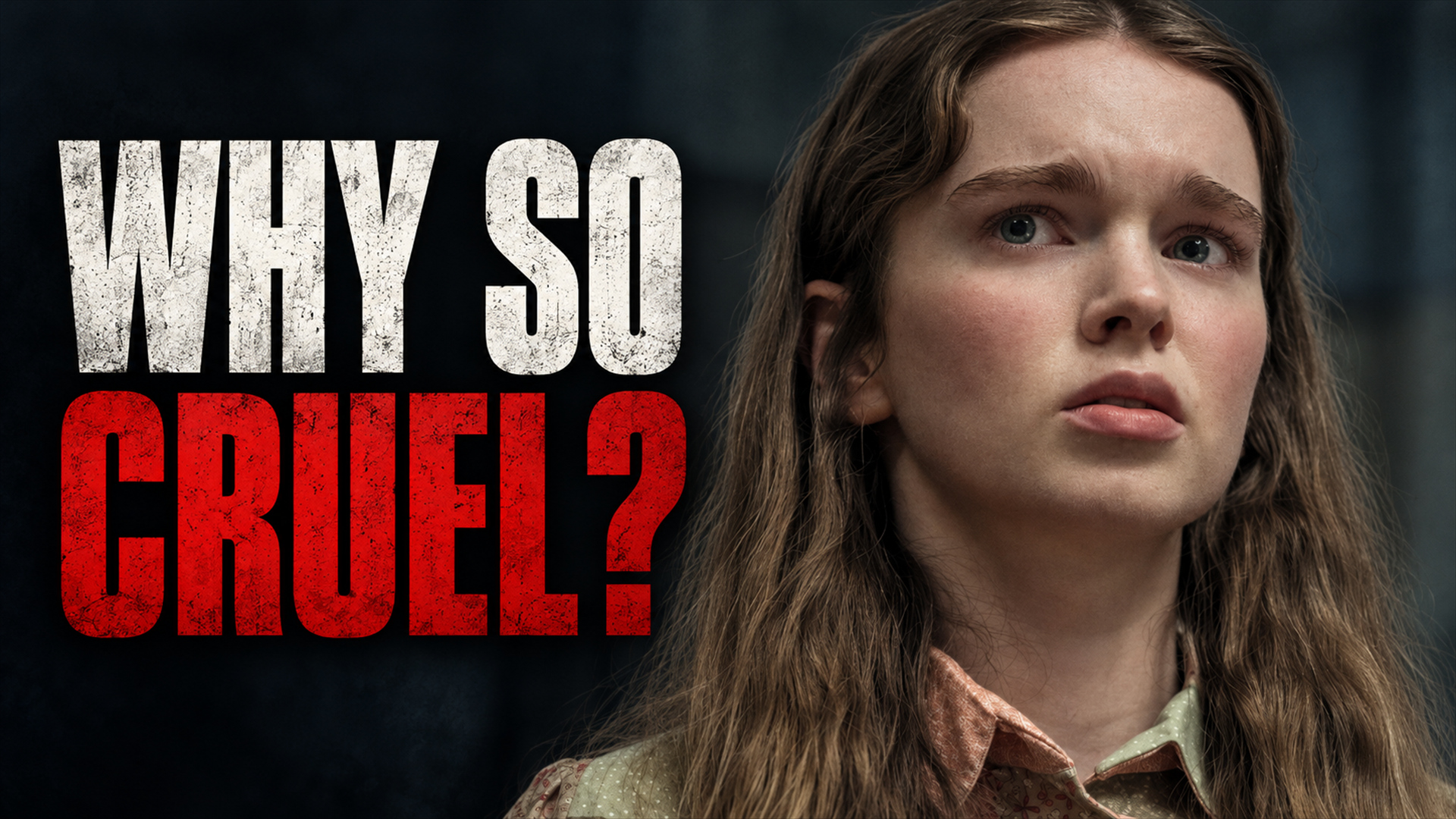
They turn a girl's humiliation into entertainment. But what happens when the girl everyone watches finally stops playing by their rules?
Carrie is Mike Flanagan's 8-episode supernatural horror drama. It reimagines Stephen King's first novel for a world where a humiliating moment can live online forever. Summer H. Howell plays a sheltered teenager entering public school after her father's death. She wants friends, freedom, and a chance to belong. What she finds is a community with plenty of opinions and very little patience.
A person before an image
The first thing this adaptation gets right is that Carrie needs a life before she becomes an image. Howell gives her curiosity, enthusiasm, and an intelligence that her upbringing has trapped behind a very narrow understanding of the world. She can be socially unprepared without being stupid. That distinction matters. If Carrie is only a collection of awkward gestures, the story becomes a countdown to the famous blood-soaked scene. Here, there is a young person with possibilities that other people keep closing off.
Samantha Sloyan's Margaret is just as important. Her religion is tangled up with conspiracy thinking, fear, and an obsession with keeping control. Yet the performance makes room for affection. That does not make her abuse acceptable. It makes the relationship harder to escape. Carrie is not simply choosing between a bad home and a good outside world. The outside world supplies Margaret with enough cruelty to make her warnings sound convincing, even while Margaret is actively damaging the daughter she claims to protect.
Humiliation with a replay button
The school scenes give this version its strongest reason to exist. A phone does more than record an insult. It gives the insult an audience, a replay button, and a life outside the room where it happened. The cruelty becomes something other people can participate in without looking Carrie in the eye. The more public her humiliation gets, the less anyone seems interested in the person experiencing it.
Flanagan also broadens the adults' role. Matthew Lillard's principal and Amber Midthunder's teacher belong to an institution that can identify a problem without having the power, support, or clarity to solve it. Good intentions are visible. So are their limits. That gives the series more to work with than a simple division between innocent teenagers and useless adults.
Alison Thornton's Chris gets more background, and Siena Agudong's Sue has room to wrestle with the gap between feeling sorry for someone and actually helping them. Explaining Chris' behavior is useful as long as it does not become an excuse. A difficult family can explain where anger comes from. It does not make the next vulnerable person a legitimate target.
The cost of eight episodes
There is a cost to this expansion. Eight episodes allow for complicated relationships, but they also give the story more chances to drift. Some supporting material earns its space; some dialogue explains feelings that the performances already communicate. This is often stronger as an uncomfortable character drama than as a relentless horror machine. If you want the tight, escalating pressure of Brian De Palma's film, the series will not consistently deliver that same experience.
Spoilers: the ending explainedOpen only if you want to know the ending.
Prom night begins with Carrie briefly getting the acceptance she has been denied. Then Chris and Billy's blood-bucket humiliation destroys that fragile moment. Carrie lashes out, the students' phones are damaged, and the falling catwalk kills Tommy. Crucially, that initial violence happens before Emaline offers to take over. The series does not give us a clean reason to say Carrie has done absolutely nothing.
Emaline's intervention changes how we understand what follows. She offers to take the wheel, and the massacre becomes entangled with another person's influence. Sue's later account also insists that other people were present. So the question is no longer just why Carrie snapped. It is how much of the destruction belongs to Carrie, how much involves Emaline, and who benefits from keeping the official story simple.
Emaline is not merely an imaginary friend. The ending identifies her as an astral projector and then brings her into the story physically. Carrie survives the confrontation with Margaret and the destruction of their house, and leaves with Emaline. That survival is the central break with the novel's ending. But leaving with someone who has helped shape the catastrophe is not the same as reaching safety.
Margaret survives the collapse too, using powers of her own. Her relief is temporary. The woman played by Kate Siegel, who has been interviewing survivors, kills her by stopping her heart. The supposed effort to reconstruct the tragedy is connected to people who can manipulate minds and conceal what they have done. The interviews were never a neutral window onto the truth.
Spoilers: the ending explainedOpen only if you want to know the ending.
That is where the ending becomes interesting to me. Almost every environment Carrie enters contains someone who claims the right to define her. Margaret calls control protection. Her classmates turn her into content. After the disaster, the interviewer's version of events threatens to become the version everyone remembers. Even the person who offers Carrie escape has already crossed the boundary between helping her and taking charge of her.
My reading is that the final escape repeats the series' central problem rather than solving it. Carrie has left one controlling relationship, but she has not yet shown that she can recognize another. Emaline may offer genuine companionship. She also has an agenda the season does not fully explain. Both ideas can exist at once. That makes the final journey less a reassuring rescue than an unresolved question about trust.
Margaret's powers sharpen that question. Her daughter is not simply the dangerous exception inside an otherwise ordinary family. The mother has abilities she understands through her own religious framework. I read that as a portrait of inherited fear: an adult treats something in her child as shameful while refusing to examine what it reveals about herself. The supernatural inheritance makes the family's emotional damage feel even more circular.
The documentary structure adds another layer. In a straightforward flashback, a survivor's account might look like evidence. Here, the person collecting that evidence can interfere with memory. We have to separate the events the finale depicts from the explanation a character is encouraged to give afterward. That does not mean every scene is fake. It means the authority of the interview is part of the mystery.
Spoilers: the ending explainedOpen only if you want to know the ending.
There is also a serious weakness in this approach. Carrie's story is powerful because compassion for her can coexist with horror at what she does. Once another character helps take control of the catastrophe, that difficult balance becomes less direct. The twist creates new questions, but it can weaken the emotional question the whole season has been building toward. Is the show deepening Carrie, or protecting her from the darkest consequence of her own story? For me, it does a bit of both, and the second part is less convincing.
Spoilers: the ending explainedOpen only if you want to know the ending.
The comparison with King's book makes the change clearer. The novel does not begin with a teenager newly discovered by social services and sent into school for the first time. Carrie has already attended school for years. Its opening presents Margaret as a widow, while the series makes Ralph's recent death the event that breaks the family's isolation. The television version therefore emphasizes a painful first encounter with society; the book emphasizes humiliation that has become routine.
The form changes too. King combines narrative scenes with newspaper reports, testimony, and supposedly factual material about Carrie's abilities. The opening's report about stones falling on the White home already makes the reader feel that a catastrophe is being reconstructed. The series keeps that impulse through survivor interviews, but gives the interviewer a direct role in the supernatural plot. A device that helps explain the past becomes an instrument for controlling how the past is understood.
The wider mythology also changes the scale. King's novel includes discussion of telekinesis and the possibility that Carrie is not the only person with such abilities. So the idea of another gifted person is not invented from nothing. What the series adds is a much more active network of people with powers, the histories of other women, and Emaline as a major participant in Carrie's decisions. A disturbing possibility at the edge of the book becomes a continuing story at the center of the adaptation.
Spoilers: the ending explainedOpen only if you want to know the ending.
Then there is the decisive difference: in the novel, Margaret attacks Carrie, Carrie stops her mother's heart, and Carrie eventually dies from her injuries after encountering Sue. De Palma's film stages Margaret's death differently, with flying knives, before the house collapses. The new series has the interviewer stop Margaret's heart instead, lets Carrie survive, and sends her into a future the original novel never gives her. Those are three different endings, with three different effects. They should not be treated as interchangeable.
Keeping Carrie alive offers an opportunity the book closes: what happens to a person after she becomes the face of a public catastrophe? Can she develop an identity beyond victim, threat, and spectacle? That could be a worthwhile continuation. But this season has to carry the emotional cost of leaving those questions open. A larger universe is not automatically a stronger ending.
Eddy’s verdict
Carrie works best when it stays close to a girl trying to understand an unforgiving world. The performances and the treatment of public humiliation give it real substance. Its mythology offers possibilities, but its final turn weakens some of the tragedy it has carefully earned. An ambitious, often compelling adaptation with an ending that asks for more trust than it fully earns: I give this season 7 out of 10.
Watch the film at home
As an Amazon Associate I earn from qualifying purchases. Using these links does not add to the price you pay.