

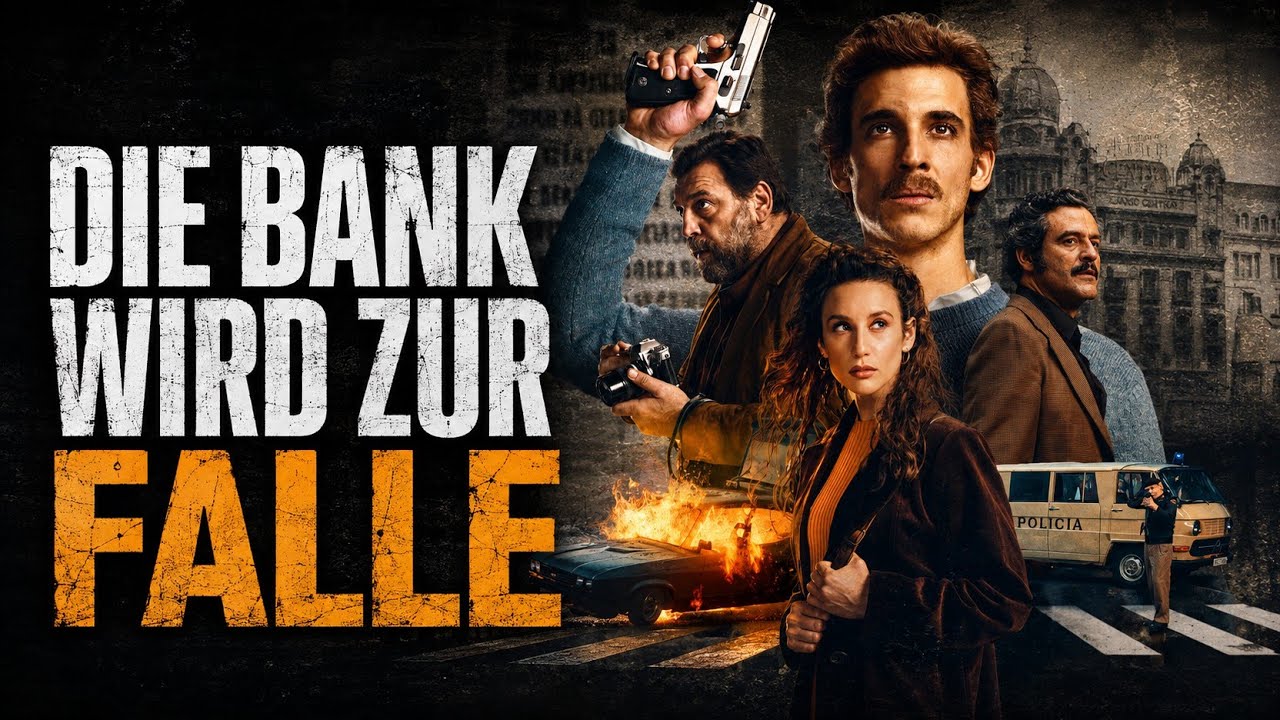
Bank Under Siege is a Spanish miniseries drawing on real events in 1981. Its robbery story gains force from the political instability surrounding it.
Story and themes
Bank Under Siege takes the May 1981 robbery of a Banco Central branch in Barcelona as the starting point for a political thriller. Eleven masked men take more than 200 hostages and demand the release of people involved in Spain’s failed coup three months earlier. Journalist Maider investigates what lies behind the siege, placing the immediate danger within the uncertainty of a young democracy. The captors threaten to kill their hostages if their demands are refused. That pressure makes the search for the real motives urgent.
Characters and performances
María Pedraza gives journalist Maider intensity and a credible conflict between professional determination and personal danger. Miguel Herrán brings conviction and internal tension to the hostage-taking side of the story. The wider ensemble adds to its emotional force. Herrán plays José Juan Martínez Gómez; Hovik Keuchkerian and Isak Férriz also give strong performances.
Direction and screenplay
Daniel Calparsoro keeps the tension alive across all five episodes. The siege feels gripping and convincingly confined. Patxi Amezcua’s screenplay combines historical facts and fictional elements, with concise dialogue that develops the characters as well as the political conflict.
Cinematography
Close-ups of the captives and captors make the emotional strain tangible, while dynamic camera movements follow the robbery’s hectic moments. Muted colours reinforce the dark mood of political unrest.
Historical context
The early-1980s setting matters. Spain’s young democracy remains fragile after the Franco regime, and the failed 23-F coup weighs on society. The real events and figures give the drama historical depth beyond the familiar mechanics of a heist.
Comparison with Money Heist
A comparison with Money Heist is understandable because of the subject and shared performers. Bank Under Siege takes a different approach, however. The historical context and political implications matter more than elaborate stylisation or ingenious plans. Miguel Herrán and María Pedraza’s involvement makes the comparison particularly easy to understand.
Verdict
Strong acting, sustained tension and the atmosphere of confinement make this an involving miniseries. Its appeal lies in the connection between personal danger and wider instability. The combination makes it essential viewing for fans of thrillers with a historical background.