

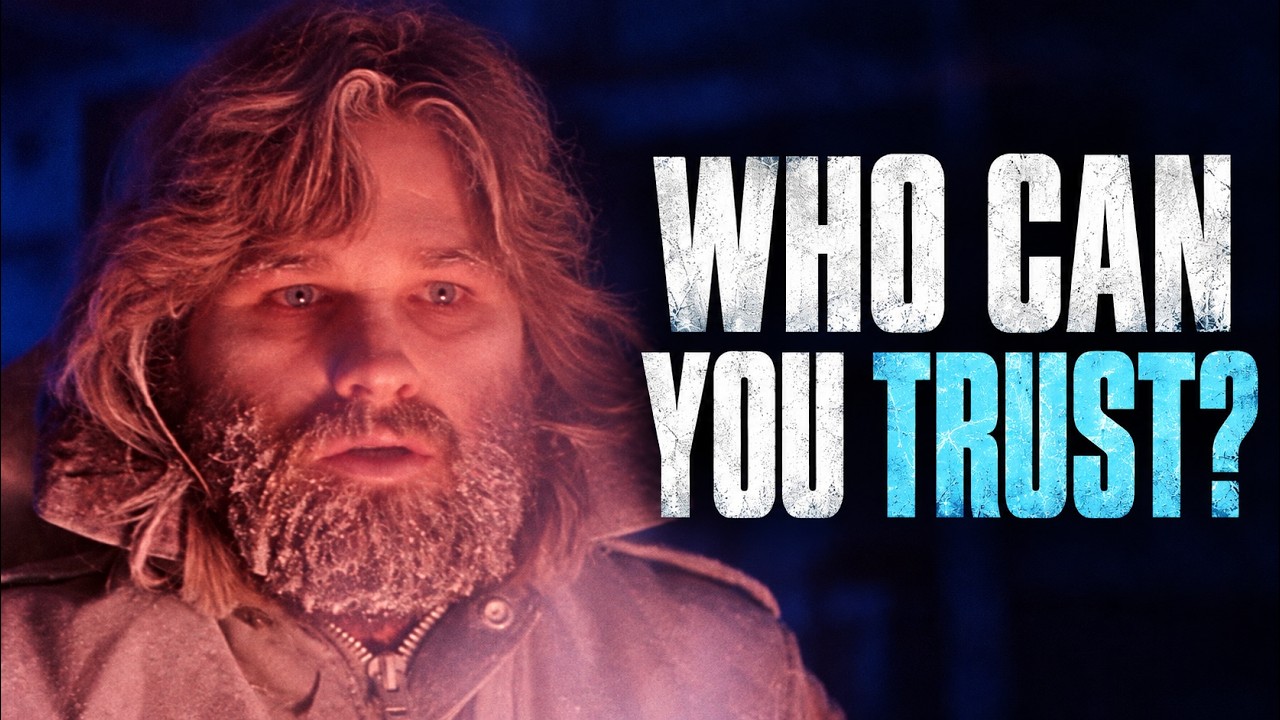
A familiar face
A monster is frightening enough. The Thing goes further: what if recognising your friend no longer means knowing who is there? John Carpenter's The Thing, from 1982, traps an American research team in Antarctica with an organism capable of imitating other life forms. Kurt Russell plays helicopter pilot MacReady.
Danger without context
The setting supplies obvious danger: cold, isolation and limited routes out. The creature adds a more corrosive problem. The men cannot rely on one another as a source of safety. Carpenter establishes that insecurity before anyone can explain it. A dog arrives, pursued by men whose urgency the Americans do not understand. What looks like an irrational threat may contain information they are missing. The opening teaches us how dangerous a reasonable response can become when the context is wrong.
A creature without a fixed shape
The practical effects, led by Rob Bottin's work, are extraordinary because the creature never settles into one reassuring design. Bodies stop behaving as coherent wholes. An ordinary shape can open into something whose parts appear to be arguing with one another. Recognition itself becomes unstable.
Suspicion in the quiet scenes
But the effects need the quieter scenes around them. A face in a doorway, an unexplained absence or a disagreement over access can become suspicious. The men begin interpreting ordinary behaviour as possible evidence of replacement. That makes cooperation harder at exactly the moment they need it most. The film does not give every team member a detailed private history. Sometimes that limits the emotional force of a death. It also denies us the comfortable belief that knowing a character's backstory would protect us from uncertainty. Familiarity is useful, but the whole premise is that familiarity can be copied.
Spoilers: detailed discussionContains story spoilers. Open deliberately.
Spoilers: The blood test
The next section includes spoilers about the blood test and the ending. The blood-test sequence gives the group an apparently objective way to restore certainty. Carpenter turns a repeated action into a timing device. We learn the procedure, wait for it to happen again, and become acutely aware of everyone who cannot move freely. A scientific-looking test does not remove the social danger of who controls it.
Protection and coercion
MacReady's authority is therefore uneasy. He makes decisive choices, but decisiveness is not proof that he understands everything. The more the station breaks down, the more protection and coercion begin to resemble each other. Survival requires trust that the men can no longer produce on demand.
An unresolved ending
At the end, MacReady and Childs sit facing an unresolved possibility. The film does not supply a reliable final test identifying one of them as the creature. Trying to turn a drink or a breath into conclusive evidence can distract from what the scene achieves: even after the spectacular destruction, the basic uncertainty remains.
Verdict
The Thing is powerful because the monster attacks a group's ability to function before it has finished attacking its bodies. The cold does not care who is human, and neither man can make the other safe by declaring himself trustworthy. Carpenter leaves the fear alive in the space between them. The film earns nine and a half out of ten.