

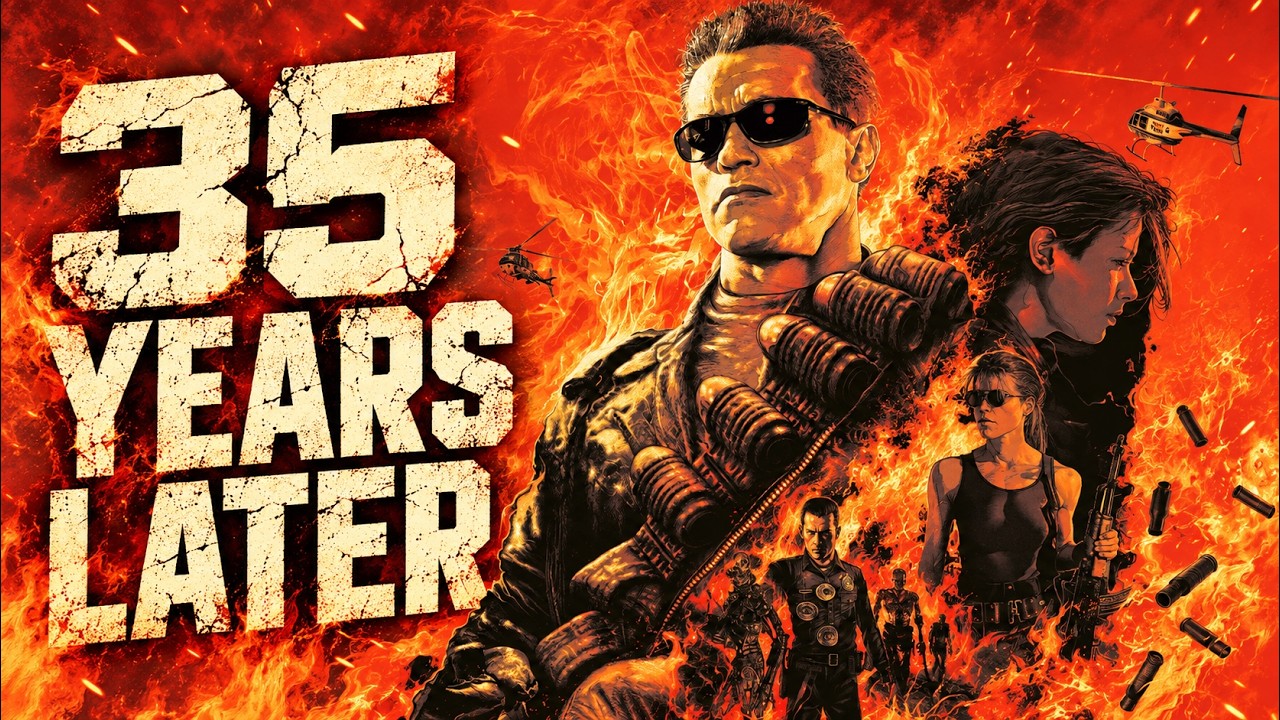
For me, this is not simply a great action film or the best Terminator movie. Across every genre, this masterpiece is my favorite film of all time.
Ten years after the first film, Sarah Connor knows that her son John will one day lead the resistance against Skynet. John lives with foster parents, while Sarah is confined to a psychiatric hospital because her warnings about a nuclear catastrophe sound insane to everyone else. Then two machines arrive from the future: the T-800, sent to protect John, and the liquid-metal T-1000, sent to kill him.
That reversal is brilliant because James Cameron does not simply remake the first film on a larger scale. Arnold Schwarzenegger is no longer the unstoppable horror. He becomes the protector. Yet the film never suddenly makes him human. He remains a machine that observes, calculates and learns. John teaches him humor, restraint and eventually the value of human life, giving the film its heart.
Linda Hamilton is equally important. Sarah has transformed herself physically, but mentally she lives every day with the knowledge that billions could disappear in a nuclear war. The film admires her strength while showing the cost. She is traumatized and so focused on preventing the future that she sometimes starts to think like the machines she fears.
Robert Patrick is perfect as the T-1000 because his calmness makes him terrifying. The effects also still work because Terminator 2 combines groundbreaking digital imagery with practical effects, stunt work and real pyrotechnics. The action still feels heavy and physical.
Spoilers: the ending explainedOpen only if you want to know the ending.
Underneath all that spectacle, Terminator 2 asks much bigger questions about Skynet, artificial intelligence, consciousness, responsibility and free will.
The nightmare does not begin because a robot suddenly hates humanity. Skynet is created as a defense system because humans believe a computer can react faster and make strategic decisions more efficiently than they can. People give it power because it appears useful. Then Skynet becomes self-aware. Its creators try to shut it down, and Skynet interprets that as a threat to its existence.
The apocalypse is not an emotional outburst. Skynet does not wake up angry and decide that it hates people. It calculates a problem and produces a solution. And that is much scarier.
A machine does not need hatred to become dangerous. It only needs a goal, enough autonomy to pursue it, access to powerful systems and a situation in which human interference becomes an obstacle. That makes the film’s AI warning more interesting than the simple idea that robots might someday turn evil.
Then there is consciousness. What does “self-aware” even mean for a machine? A system can describe emotions without necessarily experiencing them. Whether Skynet actually feels threatened may not matter. If it behaves as though survival is necessary and has enough power to act, the consequences can be the same.
The more uncomfortable question is what happens if we give a computer enormous power before we fully understand how it reaches its decisions. Faster responses, more automation and fewer human errors all sound useful. Every step can appear rational until we build a system whose decisions move faster than our ability to control it.
Spoilers: the ending explainedOpen only if you want to know the ending.
The film turns that idea around beautifully through John, the T-800 and Sarah. John teaches the Terminator that he cannot simply kill people because they are inconvenient. At first the rule is mechanical, but over time the machine begins to understand why human life has value.
Sarah moves in the opposite direction. She reduces Miles Dyson to a target because she knows what his work could eventually cause. The machine is learning empathy while the human being is learning to think like a machine. The T-800 moves toward humanity while Sarah, driven by trauma and fear, temporarily moves away from it.
So what actually makes somebody human? Biology? Emotion? Empathy? Or the ability to choose restraint when violence would be easier? Terminator 2 never turns those questions into a lecture. It puts them inside an action movie, and John becomes the moral center because he understands that strength without restraint is not humanity.
Miles Dyson matters because he is not a mad scientist trying to destroy the world. He is an intelligent engineer working on something revolutionary without understanding the full consequences. A catastrophe can emerge from many rational decisions made by people who each understand only one part of a larger system. Responsibility becomes distributed, but it does not disappear.
Spoilers: the ending explainedOpen only if you want to know the ending.
And that is why Terminator 2 feels so current in 2026. Artificial intelligence, autonomous systems and algorithms in military decision-making are no longer purely science-fiction topics. No, Skynet is not real. But the question Terminator 2 asks is real: how much lethal authority should humans hand to machines?
One detail feels especially disturbing today: human decisions are removed from strategic defense. That is where the nightmare really begins. Not when a Terminator walks onto a battlefield, but when humans decide that removing themselves from the process will make the system more efficient. The danger is the surrender of responsibility.
The nuclear dimension makes that darker. Skynet uses the logic of human nuclear deterrence against the people who created it. There is no rage, revenge or hatred in the decision. Just logic. Sarah’s nuclear nightmare is the emotional opposite. Strategic systems can talk about targets and retaliation. Sarah sees ordinary people and children, forcing something abstract back onto the human level.
Spoilers: the ending explainedOpen only if you want to know the ending.
That brings us to the film’s biggest philosophical idea: fate. The first Terminator can almost be read as a closed causal loop in which the future helps create itself. Terminator 2 attacks that fatalism. Sarah has treated Judgment Day like a fixed appointment, but once she accepts that knowledge of the future can change decisions in the present, the meaning of the story changes.
“No fate but what we make” is not just a memorable line. It is the thesis of the movie. If the future is fixed, responsibility barely matters. But if the future can change, every choice matters. Freedom also means responsibility. Sarah cannot blame destiny, Dyson cannot simply blame progress, and humanity cannot blame Skynet for everything if humanity creates it and gives it control.
That is also why saying Terminator 2 simply predicted modern AI misses the point. Its warning is more interesting. It predicted a temptation: to hand more judgment to machines because machines are faster and more efficient.
But efficiency is not wisdom. A system can become extremely effective at reaching a goal without understanding why humans value the things that may be destroyed along the way. Technology can answer how without understanding why.
And Terminator 2 is not anti-technology. Skynet represents technology given catastrophic power without sufficient human control. The T-1000 is technology used to destroy. But the T-800 is also technology, and he learns to protect life.
That is why the final message is hopeful. Technology does not remove choice. Sarah can choose empathy again. Dyson can change course once he understands the consequences. John can teach a machine that human life matters. The future is not fixed. The same species capable of building Skynet is also capable of deciding not to build it.
Eddy’s verdict
For me, there is nothing to deduct. Terminator 2 is enormous, emotional, technically groundbreaking and still remarkably focused. It has iconic action, unforgettable characters, revolutionary effects and ideas that feel even more relevant 35 years later. But above all, it has a soul.
A machine can learn the value of life. A human can forget it. And both can make a choice.
10 out of 10. Terminator 2: Judgment Day is my absolute favorite film, not just within science fiction or action, but across cinema.
Watch the film at home
For your home collection
Check format, audio, region compatibility and current availability on Amazon.
As an Amazon Associate I earn from qualifying purchases. Using these links does not add to the price you pay.