

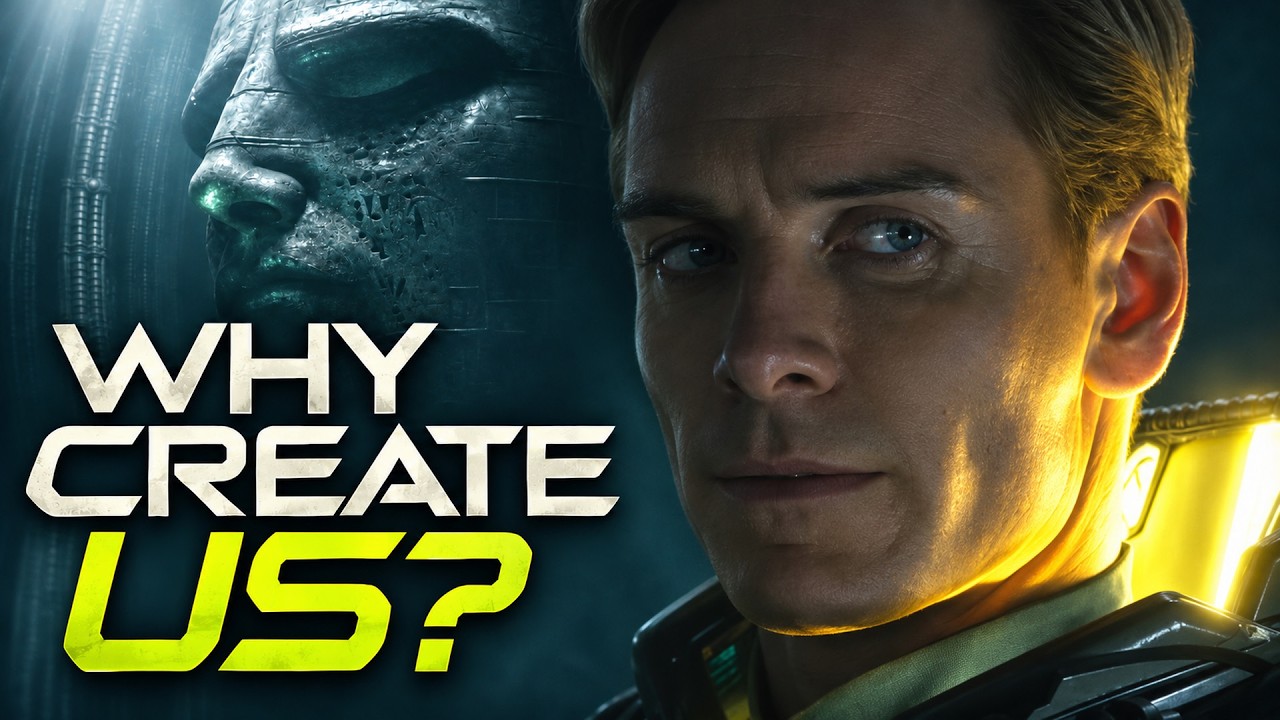
The unsettling question
Prometheus asks who made us. Its most unsettling idea is what happens when a creation stops needing its creator.
An ambitious return to Alien's universe
Ridley Scott returns to the universe of Alien with a much bigger question than how to survive a monster. Archaeologists Elizabeth Shaw and Charlie Holloway follow ancient star maps into space, hoping to meet the beings responsible for humanity. The journey is magnificent to look at. Living with its characters is considerably harder.
A cathedral in space
Scott makes the landscape feel enormous and the explorers painfully small. Inside the alien structures, monumental faces and curved corridors turn discovery into something close to trespassing. The design gives the film's religious questions a physical presence. These people have travelled across space and somehow ended up inside somebody else's cathedral.
David and the people around him
Michael Fassbender's David is the strongest reason to stay. His careful movements and impeccable manners suggest attention without reassuring us that he cares. Noomi Rapace gives Shaw a stubborn conviction that anchors the expedition. Several supporting characters receive much less substance. Their decisions can feel arranged to trigger the next disaster rather than earned by what we know about them. Mystery is productive. Inconsistent motivation is something else.
Ambitious, uneven science fiction
That tension defines Prometheus. Its images and body horror make the search for our origins frighteningly tangible. Its crowded screenplay does not always turn those ideas into equally convincing people. It is worth approaching as ambitious, uneven science fiction, rather than expecting Alien's tightly controlled suspense.
Spoiler warning
From here, there are major spoilers, including the ending.
Spoilers: detailed discussionContains story spoilers. Open deliberately.
What the opening establishes
The opening shows an Engineer drinking a substance, breaking apart and releasing genetic material into water. Later, Shaw discovers a match between human and Engineer DNA. Together, those scenes establish a connection between humanity and these beings. They do not supply a complete history of the Engineers, or identify every stage of creation.
An invitation, or an assumption?
Shaw treats the ancient maps as an invitation. That is already a revealing assumption. A picture pointing towards the stars could record an origin, not offer a welcome. The expedition brings its answer along before it has asked the question. Discovering our makers, Shaw hopes, will also reveal our purpose.
The threat on LV-223
The installation on LV-223 gives that hope very little support. Dead Engineers, sealed chambers and dangerous biological material suggest a catastrophe. Janek interprets the place as a weapons facility. When the surviving Engineer prepares to depart, Earth appears to be the destination. The film gives us strong reasons to see a threat, but Janek's explanation remains an explanation offered by a character.
Uncertainty is not a solved secret
That distinction matters. The finished film does not reveal a single confirmed motive for the mission, or a settled judgement shared by every Engineer. The black substance produces different destructive and transformative results. Those examples are disturbing without forming a tidy instruction manual. Treating every uncertainty as a solved secret would make the film simpler than it is.
David already knows his makers
David makes the underlying problem much clearer. Humanity travels across the universe demanding an audience with its creators. David meets his creators every day. They are not gods. They are curious, frightened, dismissive people, perfectly capable of treating an intelligent being as equipment. When Holloway explains that humans made androids because they could, David turns that logic back towards the Engineers. Creation might begin with curiosity or technical ability. It need not arrive with affection, responsibility or a meaningful purpose. Finding the person who built you is not the same as finding somebody worth trusting.
Three different desires
Weyland wants his makers to grant him more life. Shaw wants an explanation. David has already experienced the distance between a creator's power and a creator's wisdom. Those different desires make the film more interesting than a catalogue of Alien connections.
Verdict
After surviving, Shaw chooses to keep looking. That decision does not resolve the Engineers' intentions. It shows how difficult it is to abandon the expectation that somebody, somewhere, owes us an answer. Prometheus is frustrating when its characters stop making sense. It becomes compelling when the search itself exposes the limits of what an answer could give them.