

When familiar places stop making sense
Three of 2026's most talked-about horror movies turn corridors and roads into traps. Backrooms, Exit 8 and It Ends belong to a much older nightmare: places that look normal until reality forgets where the exit is.
Backrooms
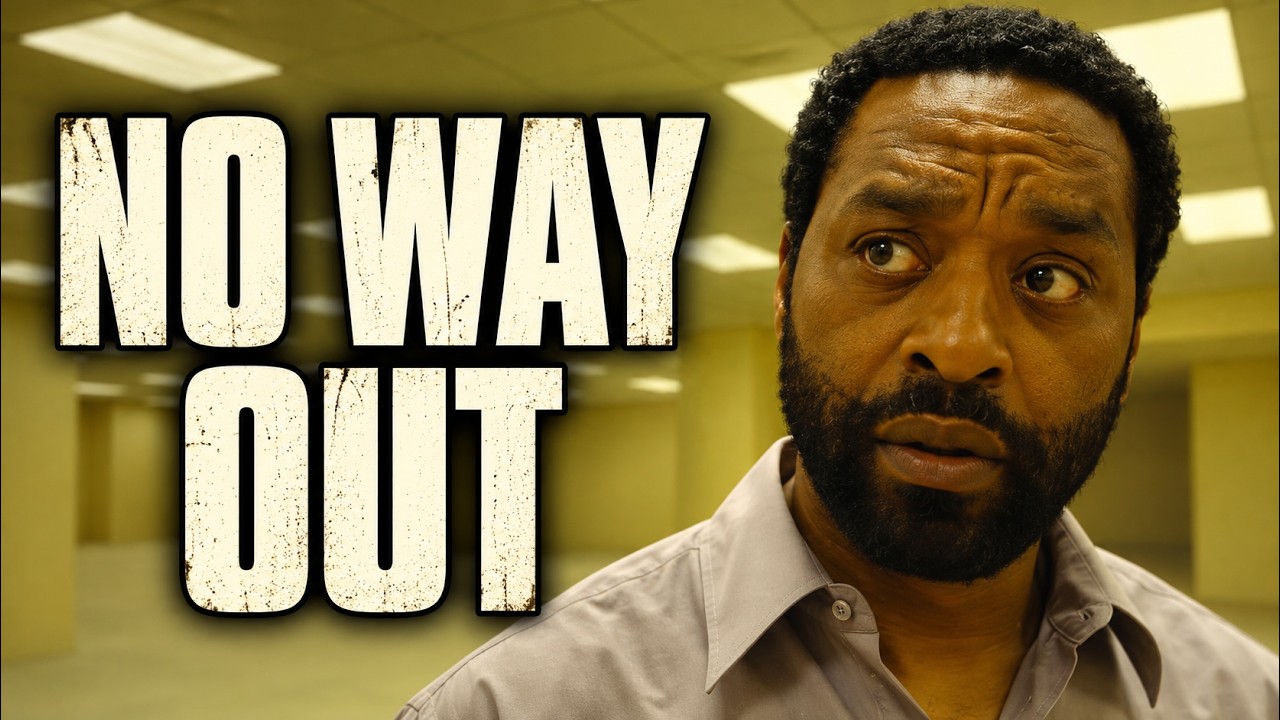
Backrooms turns an almost empty furniture showroom into the gateway to a place that feels both artificial and strangely familiar. Kane Parsons does not need an ancient castle or a remote forest. The fear comes from carpeting, fluorescent light, unfinished walls and corridors that seem designed for a purpose nobody can explain. That is the key to why the Backrooms idea became so powerful online before it became an A24 feature. These are spaces we know from offices, hotels, warehouses and shopping centers, but emptied of the people who are supposed to make them normal. The movie expands that sensation into a larger story without losing the basic unease of entering a room that should not exist. Chiwetel Ejiofor and Renate Reinsve give the impossible architecture a human center, while Parsons keeps returning to the question that makes liminal horror work: what if the safest-looking place in the world suddenly stopped obeying the rules?
Exit 8
Exit 8 reduces the idea even further. Genki Kawamura traps his protagonist in a clean underground passage where the route appears simple and the instructions are clear. The problem is attention. Every trip through the corridor becomes a test of whether something has changed, and the most ordinary detail can become suspicious once repetition teaches us exactly how the space is supposed to look. That makes the movie unusually interactive without turning it into a gimmick. We start scanning walls, signs, faces and movement along with the character. The original game built its tension from observation, and the film understands that the best adaptation is not to bury that mechanic under a completely different plot. Instead, it uses repetition as pressure. Backrooms makes us fear what could be behind the wall. Exit 8 makes us fear the wall itself, because after enough loops even a perfectly normal corridor begins to feel like evidence that reality is malfunctioning.
It Ends
It Ends moves the same nightmare outdoors. Four friends take a late-night drive and end up on a road that simply refuses to finish. Alexander Ullom trades narrow hallways for an apparently open landscape, which creates a different kind of claustrophobia. There is sky, forest and distance everywhere, yet the characters are still trapped because every mile only proves that movement is not the same thing as progress. The film premiered in 2025 and received a wider NEON theatrical push in 2026, arriving at exactly the moment Backrooms and Exit 8 made endless-space horror feel like a genuine mini-wave. What makes It Ends fit beside them is its refusal to make the impossible environment merely decorative. The road changes the group dynamic. Time becomes strange, normal assumptions stop helping, and the question is no longer simply where they are. It is how long people can keep moving when the world offers no proof that an exit exists.
Vivarium
Vivarium may be one of the clearest ancestors of this current wave. Gemma and Tom only want to look at a house, but the identical suburban development called Yonder turns the dream of home ownership into a geometric prison. Lorcan Finnegan uses repetition in a way that is almost aggressively bland: the same green houses, the same streets, the same artificial sky. The neighborhood is not ruined or visibly haunted. It is too neat, too empty and too consistent, which is exactly why it becomes disturbing. Jesse Eisenberg and Imogen Poots are not trying to solve a maze full of traps. They are trying to understand a place that has removed the basic possibility of leaving. That makes Vivarium especially close to the emotional logic of Backrooms. The horror comes from recognizing architecture designed for ordinary life and discovering that its familiarity is a disguise. A suburb becomes a loop, and normality becomes the thing that looks wrong.
Cube
Cube is the older, harder-edged version of the same fear. Seven strangers wake inside a structure made of nearly identical rooms, some safe and some deadly, with no explanation for who built it or why they are there. Vincenzo Natali turned a limited production design into the entire identity of the film. The repeated cube rooms create a system the characters desperately want to understand, and every new rule offers hope that logic might provide an exit. But Cube is not only memorable because of the traps. Its real strength is how quickly an impossible space changes human behavior. Cooperation becomes calculation, knowledge becomes power, and the architecture keeps forcing the group to reveal what they are willing to do when certainty disappears. Decades before the term liminal horror became common online, Cube understood the attraction of a location that feels like an unfinished level of reality. The rooms are simple. The implications are enormous.
Skinamarink
Skinamarink takes away even more information. Two children wake at night and discover that their home is no longer behaving like a home. Doors, windows and familiar points of orientation become unreliable, while Kyle Edward Ball keeps the camera low, dark and deliberately incomplete. The result is not a conventional maze movie, but it belongs in this conversation because it makes ordinary domestic space feel impossible. A hallway is frightening because we cannot see where it ends. A doorway matters because we are no longer sure it should be there. Where Backrooms gives us endless architecture, Skinamarink gives us missing architecture. Both exploit the same childhood-level fear: you know this place, but something fundamental has changed while you were not looking. If its slow, experimental style works on you, very few films make darkness feel this spatial.
Grave Encounters
Grave Encounters begins with a setup that seems much more familiar: a paranormal television crew locks itself inside an abandoned psychiatric hospital to film an episode. Then the building stops behaving like a building. Corridors stretch beyond expectation, routes fail, exits refuse to function normally and the crew's confident television performance collapses into genuine panic. That shift is what keeps the film relevant to the modern endless-space trend. The hospital is not simply haunted by something inside it. The architecture itself becomes hostile. Found-footage limitations help because we rarely receive a stable map of the location, and every attempt to orient ourselves depends on the same frightened people who are losing their own sense of direction. Grave Encounters is rougher and louder than Exit 8 or Skinamarink, but the core fear is surprisingly similar. The characters entered a place believing a door would still mean a way back out. The movie spends the rest of its time destroying that assumption.
The Endless
The Endless approaches the idea from a more cosmic direction. Brothers Justin and Aaron return to the community they escaped years earlier and slowly realize that the surrounding landscape is governed by patterns they do not understand. The film is less about a single corridor than a region where time and space seem to have their own rules. That gives it a different texture from Backrooms, but it scratches the same part of the brain. Every clue suggests there may be a structure behind the impossible events, yet understanding the structure does not automatically mean escaping it. The Endless also proves that liminal horror does not require anonymous fluorescent hallways. A sunny rural landscape can feel just as unreal once repetition, boundaries and invisible rules begin to replace ordinary geography. The trap is not always a room. Sometimes it is a pattern.
In the Tall Grass
In the Tall Grass turns a field beside a road into an environment that should be easy to leave and somehow is not. Vincenzo Natali, the director of Cube, returns to the idea of people trapped inside a space whose dimensions and logic cannot be trusted. The grass blocks sightlines, separates people who should be close to one another and makes basic direction almost useless. That simplicity is the film's biggest advantage for this list. There are no endless office corridors, yet the sensation is unmistakably similar: the characters keep moving through a location that appears physically ordinary while the rules underneath it become increasingly impossible. Netflix's own synopsis emphasizes that the people who enter become disoriented and unable to escape, which is exactly the bridge to the current Backrooms wave. It is a reminder that liminal horror is less about one visual style than one terrible idea: familiar space can stop leading where it is supposed to lead.
1408
1408 compresses the entire concept into one hotel room. Mike Enslin enters the Dolphin Hotel as a professional skeptic and treats room 1408 as another story he can investigate, document and leave. The room has other plans. Mikael Håfström builds the horror around the collapse of spatial certainty: doors, windows, time and perception stop behaving like reliable tools, and a location measured in a few square meters begins to feel larger than the outside world. That is why the film still connects so well to Backrooms-style horror despite coming from a very different era. It understands that the most frightening prison is not necessarily one with locked bars. It is a place that lets you see an exit and then makes the concept of an exit meaningless. John Cusack carries long stretches almost alone, so the room has to become his scene partner. By the end, architecture is not background. Architecture is the threat.
When architecture becomes the monster
Different decades, different rules, same basic fear: the place around you can stop making sense. Once architecture becomes the monster, a simple doorway can be the most frightening thing in the frame.
Films from this selection
For your home collection
Check format, audio, region compatibility and current availability on Amazon.
As an Amazon Associate I earn from qualifying purchases. Using these links does not add to the price you pay.