

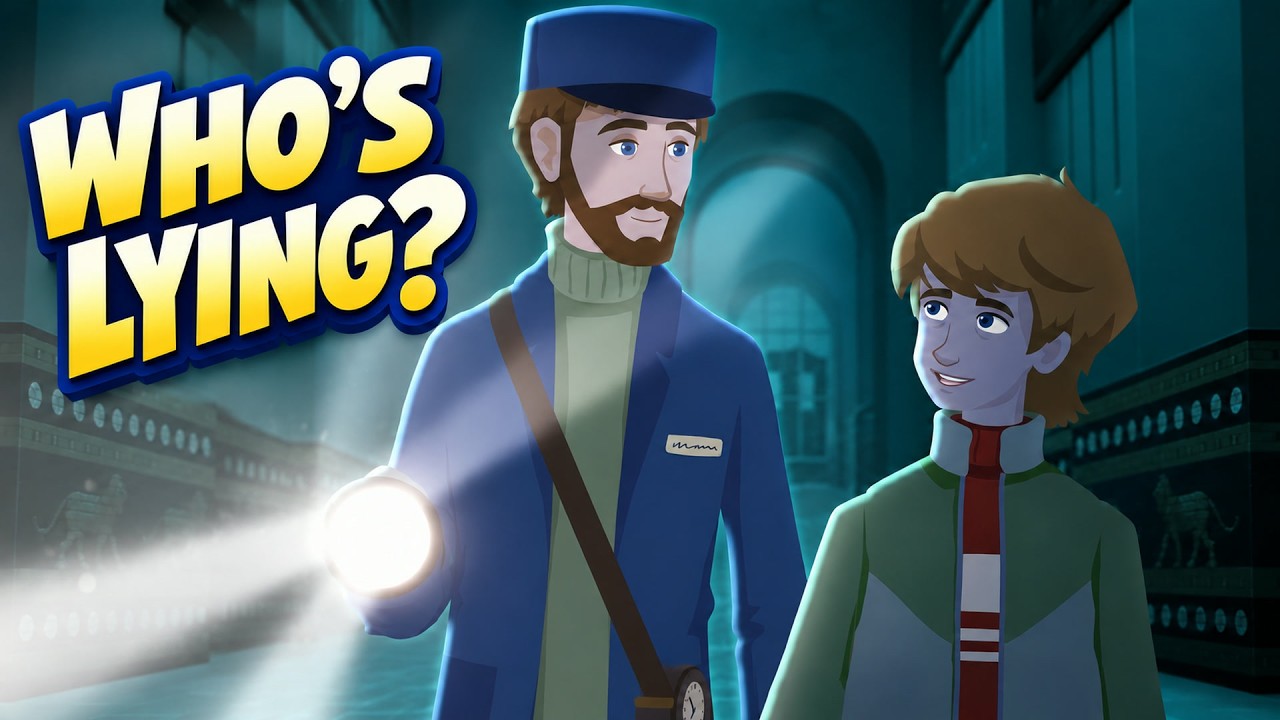
The nine-part animated series Im Labyrinth der Lügen combines historical background with a detective adventure. Adapted from Ute Krause's novel, it takes us into East Germany in 1985 through twelve-year-old Paul, who lives with his grandmother in East Berlin. Its mixture of historical detail and adventure leaves me with mixed feelings. The story is involving and takes the contradictions of a totalitarian regime seriously, but parts of the execution weaken the overall impression.
The animation is one of its most striking achievements. East Berlin in the 1980s is recreated with impressive care, from recognisable locations such as the Pergamon Museum to everyday East German objects. That attention to detail helps Paul and Millie's world feel tangible. The atmosphere has something to offer children as well as adults interested in revisiting that period.
The plot combines a mystery with a friendship developing under the pressures of East German life. Paul and Millie, both outsiders at school, investigate a mysterious stone inscribed with hieroglyphs that supposedly holds the secret of eternal youth. The mystery provides welcome suspense and keeps the adventure moving. Setting it against this historical background generally works, although the construction sometimes feels a little forced.
Paul and Millie are well developed, and their relationship is credible and warm. Millie, who is half Cuban and also faces prejudice, introduces a valuable dimension to the story. Their friendship forms its emotional centre and gives viewers people to connect with. Some supporting characters, including Paul's uncle Henri and the dubious Professor Hartwig, remain disappointingly one-dimensional despite their potential.
The treatment of the Stasi is another effective element. The series conveys the pervasive fear and mistrust people experienced in East Germany. State surveillance remains a constant threat, and scenes in which Paul and his family are watched are intense and oppressive. This gives the historical setting real weight and offers younger viewers an insight into life under that pressure.
The storytelling does have weaknesses. At times, the emphasis on suspense and drama comes at the expense of depth. A stronger dramatic arc would have helped: some episodes connect only loosely, allowing the central thread to slip out of view. The linear approach to the story described by director Theresa Strozyk may be an unusual and bold choice for a children's animated series, but it does not always produce the strongest structure.
Im Labyrinth der Lügen has attractive animation and a compelling premise, yet its execution does not consistently fulfil that promise. It offers an interesting, informative look at East Germany in the 1980s, bringing historical material and fiction together effectively. It is worth seeing, particularly for viewers interested in German history, even if this ambitious project sometimes falls short of its own aims. I do not want to be too harsh, though. It is a well-made German production with a lovely retro appearance. Its animation lacks the polish of contemporary blockbusters, and I consider that a plus. The warm undertone helps earn my recommendation.