

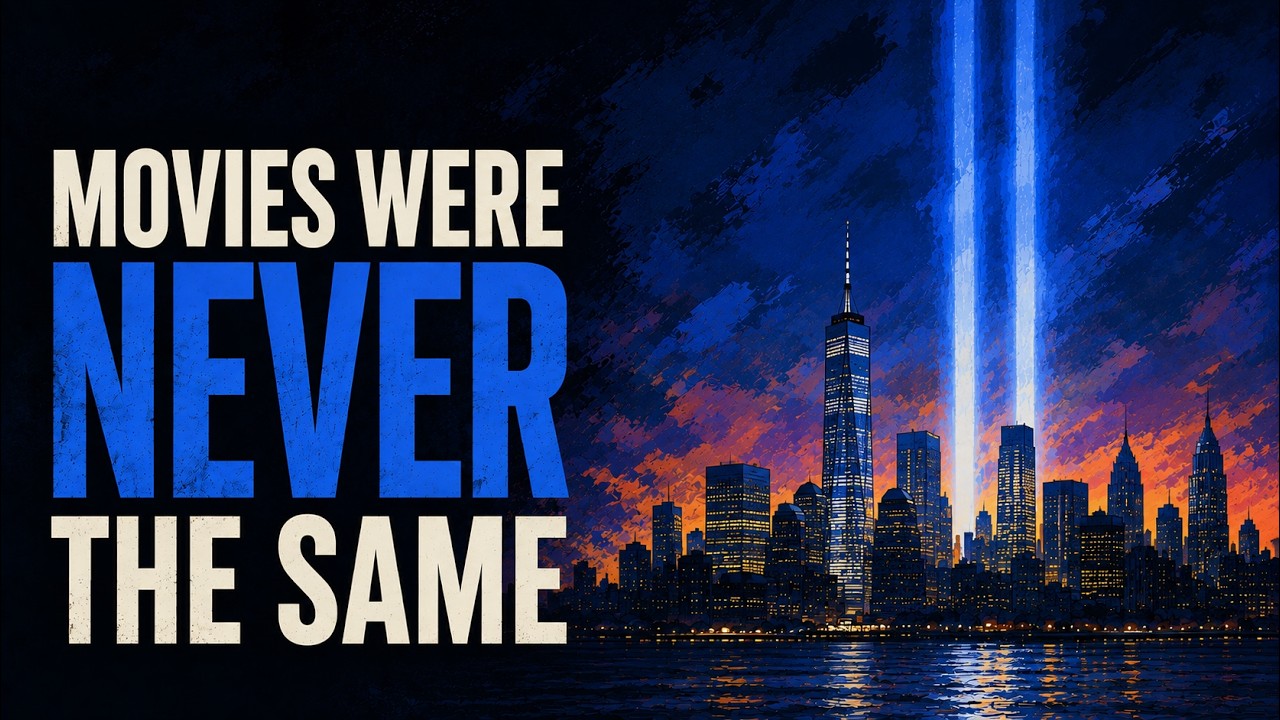
When familiar images change meaning
September 11, 2001 changed more than new film stories. Images already made were suddenly read differently. Sony withdrew the Spider-Man teaser in which a helicopter is caught in a web between the Twin Towers. Previously fantastical New York spectacle could no longer be separated from the real catastrophe.
Men in Black II also changed its planned World Trade Center finale. In Lilo & Stitch, a Boeing 747 flying near urban buildings became an alien spacecraft in a mountain ravine. Chris Sanders later described how the filmmakers revised the sequence immediately after the attacks. The movement could remain similar; its meaning could not.
War of the Worlds: catastrophe at ground level
In 2005, Steven Spielberg’s War of the Worlds tells an older invasion story with fear that belongs to its present. Destruction is not principally viewed by generals or victorious heroes. We stay with ordinary people who barely understand what is happening. Panic, dust and fragmented information define their perceptions.
Ray Ferrier cannot save the world. He tries to protect his children and keep moving. For me, this is the crucial shift: disaster cinema loses its safe distance from spectacle. Destruction becomes something people must survive in the street. The film cannot be reduced entirely to a 9/11 allegory, but it unmistakably carries that experience.
United 93 and World Trade Center: two approaches
In 2006, United 93 and World Trade Center move directly towards the day of the attacks. Paul Greengrass uses documentary-like immediacy and the uncertainty of incomplete information. Familiar mechanisms of a last-minute rescue cannot sustain this real story.
Oliver Stone instead chooses proximity to trapped officers John McLoughlin and Will Jimeno, their families and the rescuers. Where United 93 makes a collapsing system tangible, World Trade Center emphasises survival and intimacy. Both approaches reveal the difficulty of depicting real suffering without converting it into ordinary entertainment spectacle.
The Dark Knight: security as a moral trap
The Dark Knight is not a straightforward retelling of the attacks, and the Joker cannot usefully be equated with a real perpetrator. The story’s security thinking is more interesting: an enemy spreads fear, breaks rules and forces institutions into decisions that change them.
Batman crosses boundaries too. Interrogation, extraordinary power and extensive surveillance belong to the conflict. The question shifts: it is not only how catastrophe should be represented, but what a society accepts in order to prevent it. That moral uncertainty shapes many thrillers and superhero films from the War on Terror era.
Cloverfield: the monster and the memory
Cloverfield returns to the physical experience of images in 2008. A fictional monster attacks Manhattan, but handheld footage shows fleeing people, smoke, dust and events that remain larger than the frame. We are placed inside confusion instead of calmly observing.
For me, the connection to 9/11 is not an equation between monster and attack. It lies in the visual memory of urban catastrophe. Genre cinema can destroy New York for entertainment again, but the images do not simply recover their previous innocence.
Zero Dark Thirty: permanent emergency
Zero Dark Thirty centres on the attacks’ consequences: intelligence work, detention, torture, surveillance and years of uncertainty. Institutions are powerful without being infallible. Kathryn Bigelow does not tell the hunt for bin Laden with the simple certainty of older action films.
The controversial portrayal of torture is among the questions the film raised. What particularly interests me here is how the security apparatus itself becomes dramatic routine. Screens, data and interrogation shape the action. What happens to a society when permanent emergency comes to feel normal?
When the visual language becomes routine
In The Avengers and Man of Steel, collapsing towers, dust clouds and stunned civilians already belong to the language of blockbuster finales. This does not mean every destroyed skyscraper must be a deliberate 9/11 reference. Cultural memory nevertheless changes how these images feel.
They can make destruction immediate and weighty. If they are used only to make a finale bigger, remembered suffering risks becoming scenery. The important question is therefore not simply whether a film uses these images, but what perspective and weight it gives them.
Twenty-five years later: cinema and rebuilding
For me, the aftershock remains in the dust cloud, the surveillance screen and the morally compromised protector. It reaches beyond individual genres. Not every film directly addresses the attacks, but many carry changed ideas about fear, security and responsibility.
The documentary Tribeca 25 was released on Netflix on September 11, 2026. It looks at the festival founded after the attacks to help revitalise Lower Manhattan. This is a fitting closing point: 9/11 changed cinema, and cinema also became part of how New York rebuilt.
Watch the film at home
As an Amazon Associate I earn from qualifying purchases. Using these links does not add to the price you pay.