

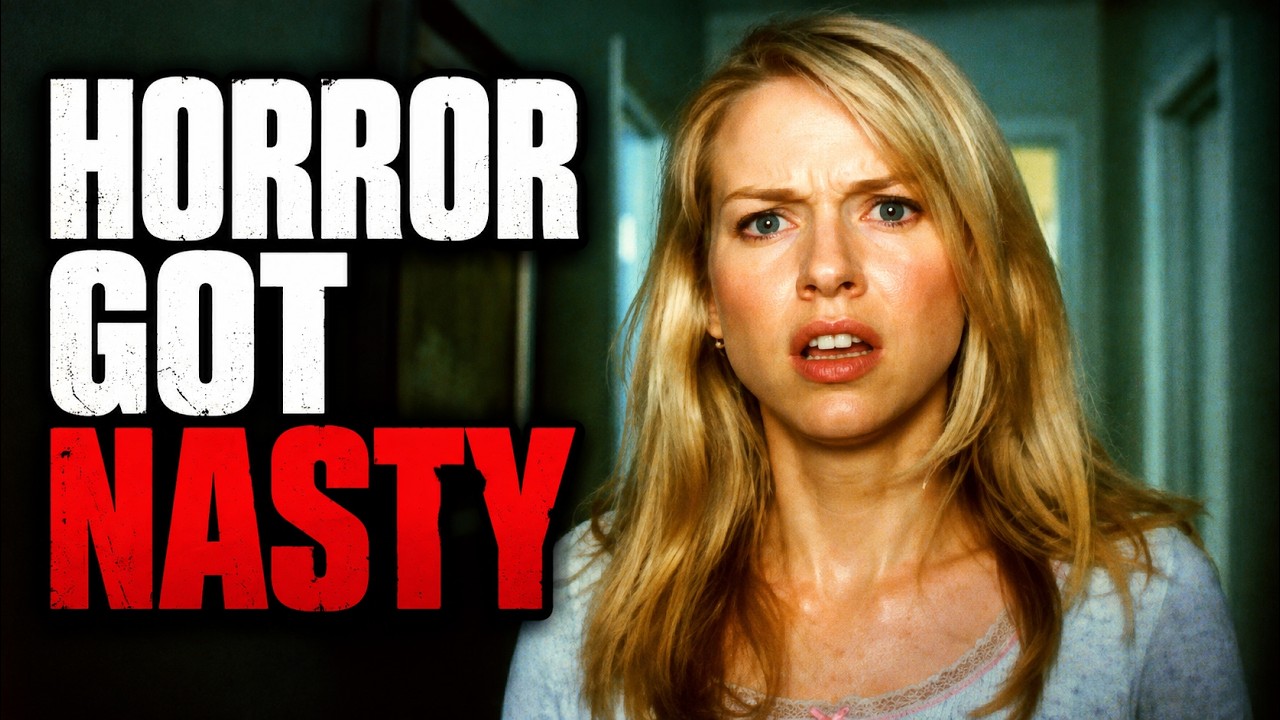
The 2000s had cursed tapes, empty highways, strangers at the door and films that could make an ordinary phone ring feel dangerous. These are the ten that hit hardest.
10. 28 Days Later
Danny Boyle takes the end-of-the-world movie and strips away the comfortable distance. The digital-video look is rough, immediate and almost ugly in exactly the right way. Empty London does not feel like a giant effects showcase. It feels abandoned. Cillian Murphy gives Jim enough vulnerability that the film never becomes a simple survival power fantasy, while Naomie Harris brings a harder edge without turning into a genre stereotype. What really keeps 28 Days Later in the head is how the story keeps changing shape. The infected are terrifying, but the film understands that panic also changes the people who are still alive. It grows more uncomfortable without needing to explain every ugly possibility in advance. Number 10 sounds low for a film this influential, but the 2000s were simply overloaded with strong horror.
9. The Others
Alejandro Amenábar builds almost everything from restraint: closed curtains, quiet rooms, footsteps, whispers and the feeling that a huge house can somehow become claustrophobic. Nicole Kidman is the center of it. Grace is rigid, exhausted and constantly trying to impose order on a place that refuses to behave. The film is elegant enough to look almost old-fashioned, but that is exactly why the tension works. It does not chase the audience with noise every few minutes. It teaches you to listen. The darkness has rules, the rooms have weight, and even small sounds start to matter. The Others is also a reminder that a horror film can be extremely controlled without becoming cold. It is less aggressive than most of this list, but its atmosphere is so complete that it still feels like entering a sealed-off world.
8. Final Destination
As a pure horror ranking, it lands lower than its overall value suggests, because Final Destination also has the energy of a giant entertainment event. The entire movie is built around anticipation: once the basic idea is established, ordinary objects become part of a machine you keep trying to read before it moves. That makes the set pieces frightening, but also weirdly fun to watch. I had the movie on VHS and watched it so often that I no longer know the exact number. Ten to twenty times at least, maybe even more than twenty. It is one of my favorite movies, period, and every sequel has been part of the ride. Final Destination: Bloodlines gave the series a strong jolt again in 2025. The first film still has a special tension because it is not yet trying to outdo a whole franchise history. And yes, every time Devon Sawa appears, one thought still flashes through my head: that is Stan from Eminem's music video. The film sits at eight only because the seven above it hit harder as horror.
7. Saw
Before the franchise became associated with increasingly elaborate traps, the first Saw was a dirty little thriller with a very simple strength: confinement. James Wan does not need a huge world. He needs one filthy room, two frightened men and a question that keeps getting worse. Cary Elwes and Leigh Whannell sell the desperation, while the rough visual style gives the film an almost diseased texture. The violence matters, but the anticipation matters more. Saw constantly makes the audience imagine what might happen before showing what actually happens. That is why the first film remains more effective than its reputation as merely the beginning of "torture porn" suggests. It is clever, nasty and cheap in a way that becomes an advantage. You can feel a young filmmaker trying to squeeze every possible ounce of tension out of limited space.
6. 1408
A hotel room should be one of the safest, most anonymous spaces imaginable. Mikael Håfström turns that anonymity into the entire problem. John Cusack carries enormous stretches of the film almost alone, and that is exactly what makes the room work. Mike Enslin enters as a professional skeptic who has turned disbelief into a career, so the film gets to attack not only his body but his certainty. The strongest parts of 1408 are not about showing some enormous monster. They are about destroying the reliability of space, time and routine. A window, a clock, a phone or a familiar song can suddenly become hostile. Samuel L. Jackson barely needs screen time to make the warning feel serious. 1408 is one of those studio horror films that looks accessible on the surface and then becomes much stranger once the door closes.
Honorable mentions
REC is one of the defining found-footage horror films of the decade, even if its frantic energy lands as much as dark fun as pure terror here. Orphan is slick, nasty and powered by a performance that makes the entire film more uncomfortable than its polished surface suggests. Silent Hill is uneven as storytelling, but its production design, sound and oppressive atmosphere remain unusually committed for a video-game adaptation. Paranormal Activity built an empire out of almost nothing, yet the minimalism never became truly frightening here, and the ending feels more like jump-scare punctuation than lasting dread. Drag Me to Hell is even easier to admire than to fear, because Sam Raimi deliberately pushes disgust, slapstick and cruelty together until horror starts laughing at itself.
And then there is The Hills Have Eyes. I actually owned the DVD and stopped the film the first time because the people and the atmosphere felt so unpleasant. Years later, I watched it again and some of its extremity played almost funny, but the basic mood still works. The film feels dirty, hostile and physically wrong. Alexandre Aja makes the landscape itself seem contaminated. That repulsive quality is exactly why it deserves an honorable mention, even if it does not make the final ten.
5. The Strangers
This is horror built from a brutally simple fear: somebody is outside, and there may be no reason you can understand. Bryan Bertino does not need mythology or a complicated supernatural rule. He needs distance, darkness and the possibility that a figure might be standing in the background before the characters notice. Liv Tyler and Scott Speedman play the tension with enough emotional awkwardness that the house never feels like a neutral game board. Something is already wrong between them before the real terror begins. The Strangers is especially good at withholding movement. A doorway can stay empty just long enough to make you scan it, and a quiet exterior can feel more threatening than a loud attack. The movie sometimes gets reduced to its masks, but the real weapon is how helpless random attention can feel.
4. The Grudge
The American remake keeps the Japanese setting and Takashi Shimizu behind the camera, which already makes it a stranger remake than the usual Hollywood relocation. Sarah Michelle Gellar gives the film an accessible center, and the bigger studio production makes some of the imagery cleaner and more immediate. It works. The sound design is memorable, the house feels contaminated, and the curse has the nasty quality of not caring whether someone understands it. But the remake is one step below the original because the increased clarity also removes a little of the raw wrongness. The Grudge is excellent at making familiar J-horror imagery legible to a wider audience. Ju-On is better at making that imagery feel like it should not exist in the first place.
3. Ju-On: The Grudge
This is the stronger version because it feels less interested in comforting the viewer with conventional storytelling. Takashi Shimizu builds the film in fragments, repetitions and encounters that seem to infect one another. The house is not simply a location where something bad happened. It feels like a wound that keeps reopening. The low-budget texture helps. Images can feel flat, mundane and suddenly impossible without the polished warning signs Hollywood usually gives you. The sound associated with Kayako became iconic for a reason, but the deeper fear is the absence of a clean escape route. Ju-On is not scary because the characters fail to solve a puzzle. It is scary because the idea of solving it barely seems relevant. The remake is very good. The original is just a little colder, stranger and harder to shake.
2. The Ring
Ringu from 1998 is the source, and it deserves to be discussed here even though it cannot take a 2000s ranking slot. The Japanese original may even have a slight edge in pure unease, while Gore Verbinski's remake is one of the rare American versions that becomes a great horror film on its own terms. The green-gray photography makes the whole world look sick. Naomi Watts gives Rachel urgency without turning the investigation into an action movie, and the cursed videotape is disturbing because its images feel almost meaningful without ever becoming comfortable.
The Ring also gave me one of those stupidly perfect real-life horror moments. I was watching it with my sister when the telephone suddenly rang during the film. We just looked at each other. I picked it up and said "Hallo?" with a genuinely shaky voice, already half-expecting the movie to have somehow crossed into the room. It was just someone conducting a survey. "No interest, thanks, bye." Nothing happened, obviously, but for a few seconds The Ring had completely rewritten what an ordinary phone call meant. That is horror doing its job.
1. The Exorcism of Emily Rose
This could easily have been treated as another possession movie, but Scott Derrickson gives it a structure that makes the material more disturbing rather than less. The courtroom framework forces two incompatible explanations to exist beside each other. Medical reasoning, faith, fear and doubt keep pressing against the same events, and the film refuses to become comfortable simply because one character believes something strongly. Laura Linney and Tom Wilkinson give the legal side weight, but Jennifer Carpenter is the performance that stays lodged in the memory. The physical commitment is extraordinary without turning Emily into a special-effects object.
What makes the film number one is the lingering effect. Long after watching it, the performance and the way individual moments were staged kept resurfacing in my head. It felt carefully made, genuinely disturbing and far more serious than the title might suggest. The horror is not only in what might be supernatural. It is in the possibility that certainty itself is unavailable. That combination of acting, atmosphere and structure makes The Exorcism of Emily Rose the strongest horror film on this list.
Verdict
The 2000s could be glossy, filthy, supernatural, cruel and strangely playful. At their best, they made fear feel impossible to standardize.
Films from this selection
Prime Video
Check current offers and terms on Prime Video.
For your home collection
Check audio tracks and region compatibility on Amazon.
Check format, audio, region compatibility and current availability on Amazon.
As an Amazon Associate I earn from qualifying purchases. Using these links does not add to the price you pay.