

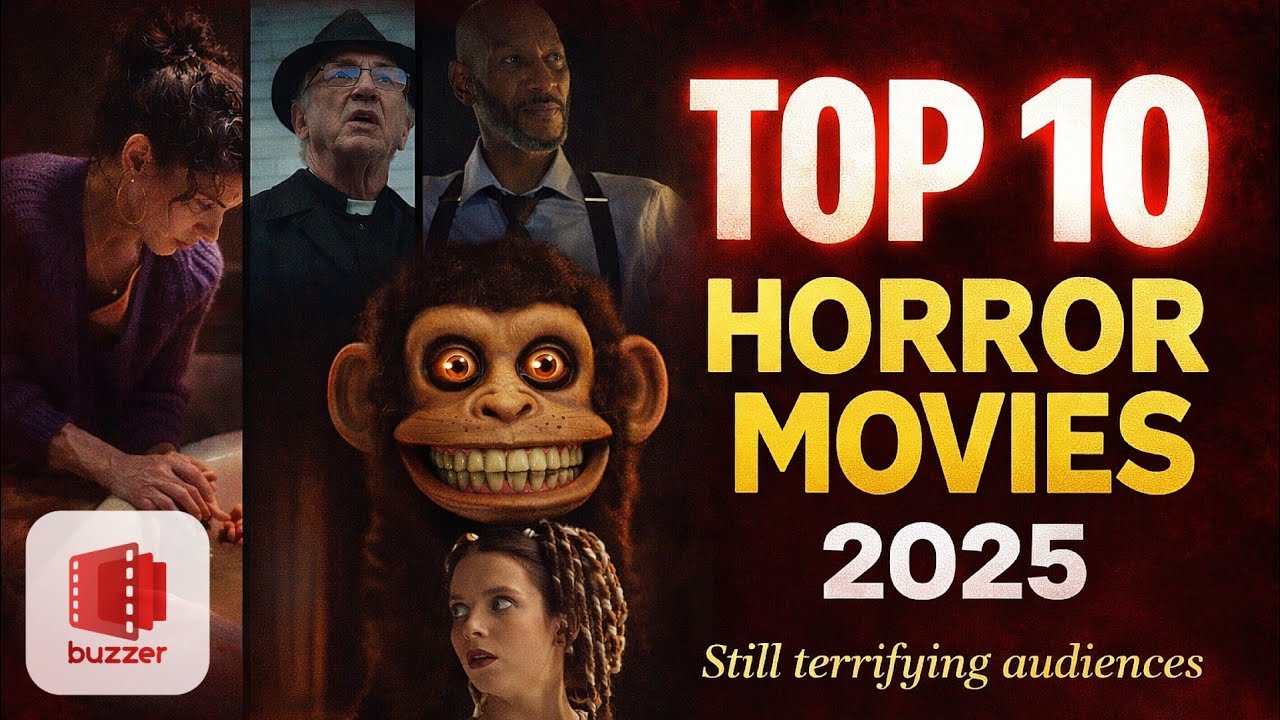
My horror selection from the 2025 video considers atmosphere, substance and impact. The ranking moves from number ten to number one, with separate honourable mentions. This is my selection from that year’s viewing; not every title had its international premiere in 2025.
10. Until Dawn
Until Dawn surprises with a concept that refreshingly breaks away from the typical slasher format, even though it initially looks like just that. David F. Sandberg doesn’t use the well known video game as a narrative foundation, but rather as inspiration for a structurally complex, visually dense horror film. What starts as a teenage horror trip to a remote valley quickly unfolds into a time loop nightmare that reveals new genre elements with every cycle, from classic slasher to supernatural body horror. The protagonist Clover, played by Ella Rubin, carries the film with believable emotion, torn between trauma, despair, and rage. Especially impressive is how the film reflects on the genre without getting lost in meta commentary.
The use of practical effects and the deliberate play with darkness and space harken back to horror films from the late eighties, yet Sandberg’s precise direction keeps everything from feeling dated. The film's second half requires some patience, as the story becomes intentionally more chaotic, but that’s exactly what makes Until Dawn compelling. It’s not about clean resolution, but about enduring and surviving. A cinematic experiment that takes risks and gets rewarded for it.
9. 28 Years Later
28 Years Later is not a nostalgic sequel, but a furious, fractured farewell to a world that can’t be saved. Danny Boyle achieves something rare with the continuation of his own classic, he pushes the Rage Virus saga forward without clinging to past successes or giving in to easy fan service. At the core is the relationship between a father and son who leave their isolated island and face a new kind of madness. Shot on iPhone, the visual rawness makes the chaos of the story feel brutally real. Particularly powerful is how the film contrasts violence with silence, sometimes there's just the sound of breathing, then a scene erupts in fiery frenzy.
Not all narrative transitions are seamless, but the emotional core is strong, it’s about fear, responsibility, and the question of what’s left of humanity when everything else collapses. 28 Years Later is demanding, loud, bold, and that’s exactly why it’s one of the strongest entries of the year.
8. The Monkey
The Monkey is probably the weirdest horror film of the year, and I mean that in the best way. Osgood Perkins adapts Stephen King’s short story into a macabre family tale full of dark humor, eerie symbolism, and grotesque death. At the center, a cursed toy monkey whose drum heralds death, sometimes creeping, sometimes brutal. Theo James plays twin brothers haunted by the curse for decades. Their story is steeped in trauma, guilt, and the futile attempt to control the past. The Monkey is never conventional, the direction shifts between nightmarish horror, exaggerated over the top gore, and quiet tragedy. The tone is especially striking. The film plays with stylistic contradictions, some scenes verge on parody, only to suddenly hit with emotional weight. The monkey becomes a symbol of buried fear, the ticking metronome of inevitable doom. A wild, bold film about trauma, death, and the things you can’t shake, no matter how deeply you bury them.
7. The Ugly Stepsister
The Ugly Stepsister transforms the Cinderella motif into a dark nightmare about beauty obsession, self denial, and societal cruelty. Director Emilie Blichfeldt delivers a debut film that boldly embraces the physical and comes with an uncompromising aesthetic. At the center is Elvira, the "ugly" stepsister, whose quest for self optimization leads to grotesque and painful transformations, surgical, psychological, symbolic. The film blends fairytale elements with radical body horror without relying solely on provocation. The camera often remains static and observant as the main character breaks down, not from external violence, but from her own desire to be accepted. Despite narrative rough patches, especially in the subplots, the main arc stays focused. The music, makeup, and production design push the film into an almost theatrical exaggeration. The Ugly Stepsister isn’t feel good cinema, it’s an angry response to centuries of idealized femininity, raw, unrelenting, and important.
6. Final Destination: Bloodlines
Final Destination 6: Bloodlines does exactly what many had long given up hope for, it revives a franchise thought to be dead, and does so with new meaning. Instead of focusing solely on spectacular death scenes, this sixth installment builds a deeper backstory that reinterprets the concept of “cheating death“. The idea of a “bloodline“ tied to supernatural guilt adds depth without weighing the film down. The death sequences remain elaborate and creative, but this time they don’t feel like grotesque carnival tricks, they feel like unavoidable chapters in a larger narrative. Visually, the film shines with clear imagery, thoughtful sound design, and a refined sense of timing. The characters are mostly functional, but feel less like cannon fodder than in previous entries.
What makes the film stand out is its attempt to give Death a mythology, not a new idea, but this time, it works. Bloodlines is more gripping than the title suggests, and perhaps the best entry in the series.
5. Together
Together isn’t a film that screams, it whispers, scratches, clings to your psyche, and doesn’t let go. Director Michael Shanks tells the story of a couple who, after an accident, are literally fused together, physically and grotesquely. But instead of leaning into shock value, the film uses its body horror premise to tell a deeply tragic yet darkly comedic tale of emotional dependence. Alison Brie and Dave Franco never play it safe, they push their characters to the brink and expose what many relationships hide. The handcrafted effects and minimalist setting intensify the intimacy, every scene feels tight and pressing. The overall effect is like a stage play you can’t walk out of. Even though the final third loses a bit of momentum, the overall impression remains strong. This film doesn’t aim to please, it aims to hurt, move, and release. And it does that in a hauntingly powerful way.
4. When Evil Lurks
Demián Rugna’s When Evil Lurks premiered internationally in 2023 and appears here in the personal selection from my 2025 video. Demián Rugna delivers a piece that refuses to compromise, neither in its storytelling nor in its depiction of evil. Two brothers discover a mutilated corpse in a small village, and what unfolds is not a typical exorcism story, but a hopeless descent into a world where evil has no form and no morality. The film rejects genre conventions, remains unpredictable, grim, and disturbingly realistic. The depiction of rural isolation heightens the sense that there’s no escape. The camera observes with cold detachment, the soundtrack is sparse but effective. There’s no hero’s journey, no goal, only escalation. The violence is raw, and the consequences are final.
What impressed me most, the film explains little, trusting its atmosphere and the idea that the unspeakable can sometimes be more powerful than any plot. When Evil Lurks feels like a nightmare you can’t shake, grounded, brutal, and courageous in extinguishing any sense of hope.
3. Weapons
Weapons is less of a horror film and more of a dark, psychological puzzle about collective fear. Director Zach Cregger takes an unconventional approach to the genre, the film starts with the mysterious disappearance of almost an entire school class, with one child remaining. But instead of following a linear investigation, the story is told in chapters, each with a new perspective, character, and narrative break. Julia Garner plays the emotional anchor as the teacher, and Josh Brolin delivers a raw, vulnerable performance as a grieving father. The film’s strength lies in its fragmented form, it does reach a resolution, but its effect goes beyond solving the mystery, building a dense atmosphere of mistrust, guilt and loss of control. The camera is static, observant, almost documentary like, as the horror slowly creeps into frame. Weapons demands focus and a willingness to sit with uncertainty. It’s a film built on what’s left unsaid, and that’s where it hits the hardest.
2. Nosferatu
Nosferatu isn’t just a remake, it’s a dark visual ritual. Robert Eggers crafts an homage to Murnau’s silent classic without getting lost in reverence. Instead, he creates a standalone film that taps into primal fear using modern techniques. Bill Skarsgård’s Orlok is no caricature, he’s an animalistic, tragic vampire, a figure between human and myth. Nicholas Hoult impresses as Hutter, driven by duty, fear, and dependency, while Lily-Rose Depp adds unexpected depth to the character of Ellen. Jarin Blaschke’s cinematography is a highlight, the compositions nod to German expressionism but employ modern tools to create a tangible atmosphere. The colors are muted, and the light often feels like its own character, shadows become figures. The story itself is stripped down, but every scene is loaded with weight. Nosferatu is more than a vampire movie, it’s a meditation on desire, power, and what’s been lost. Not a film for cheap scares, but for slow, stylish dread.
Honourable mention: Possession
Possession is not a new film, but its restored version feels more current than ever. Andrzej Zulawski’s 1981 masterpiece remains one of the most disturbing and psychologically intense horror films of all time. The 4K restoration doesn’t just revive the visuals, it puts Isabelle Adjani’s legendary performance back in the spotlight. The iconic subway scene hasn’t lost any of its power. Blending relationship drama, madness, and supernatural terror, the film unfolds into a nightmare that crosses all boundaries. If you’ve never seen Possession, you’re in for one of the genre’s most unforgettable experiences.
Honourable mention: Thanatomorphose
Thanatomorphose is a relentless body-horror film whose inclusion here concerns the older film rather than a new production. The story of a woman whose body slowly decays while she’s still alive is more than just grotesque, it’s a metaphor for isolation, psychological disintegration, and existential erasure. The film is hard to stomach, radical, and shocking. But it proves that body horror can also be art, if you’re willing to really look.
Honourable mention: The Conjuring: Last Rites
The Conjuring 4: Last Rites is the emotional conclusion to one of the most successful horror franchises of recent decades. Lorraine and Ed Warren return, this time with a more personal storyline and a retrospective that links past and present. Michael Chaves directs with his usual competence, while Vera Farmiga and Patrick Wilson deliver solid performances. Yet despite some big moments, much of it feels formulaic and overly familiar. For fans who grew up with the Conjuring universe, it’s a respectful but safe farewell.
1. Bring Her Back
Bring Her Back is the most disturbing film of the year, not because it relies on terror, but because of what lies beneath it. Danny and Michael Philippou tell the story of Andy, a teenager who, after his father’s death, is placed in the care of a woman who’s hiding far more than she reveals. What follows is a psychological horror journey about control, grief, occultism, and the desperate wish to undo the irreversible. Sally Hawkins plays Laura with a chilling intensity, shifting between care and fanaticism, her performance is among the year’s finest. The direction avoids cheap thrills, focusing instead on atmosphere, claustrophobic spaces, and unsettling rituals.
Particularly striking is the symbolism of sight, Andy’s visually impaired younger sister, Piper, is at the center of a system that tries to heal loss through violence. Bring Her Back features scenes that sear into your memory, not through blood, but through emotional inevitability. The film isn’t loud, fast, or easy. But that’s its strength, it brings horror back to where it’s most terrifying, into the private, the seemingly safe, the family. A standout film that doesn’t scream, it whispers, until you can’t take it anymore.
Watch the film at home
As an Amazon Associate I earn from qualifying purchases. Using these links does not add to the price you pay.